 BRAINCAKE
Trends in Ionisation Energy
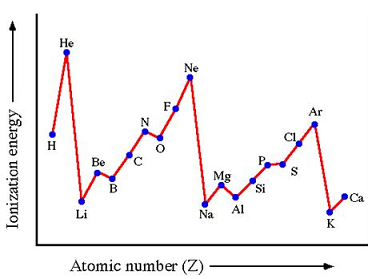
Ionisation energies increase across a period. This is because the nuclear charge is increasing as there are more protons, but the amount of shielding is the same or similar so the atomic radius decreases across a period.
Shielding refers to the repulsion of the electron to be removed by the electrons in the inner shells.
From group 2 to 3 however, the ionisation energy decreases. This is because elements in group 3 have their outer electron in the p orbital, which is of slightly higher energy than the s orbital outer electrons of group 2 elements. The p orbital electron in group 3 needs less energy to remove it.
Sign in free to see the rest of this lesson, the R.E.C.I.P.E. recall steps and the quiz
BrainCake is free. Make an account in seconds and pick up where this page stops.
Key terms in this lesson
- Ionisation
- The loss or gain of electrons by an atom or molecule to form a charged ion.
- Electron shell
- A main energy level occupied by electrons, given a principal quantum number n, with n = 1 closest to and lowest in energy relative to the nucleus.
- Atomic orbital
- A region in space where there is a high probability (90-95%) of finding an electron.
- Group
- A vertical column of the periodic table, containing elements with the same number of outer-shell electrons.
- Period
- A horizontal row of the periodic table, containing elements with the same number of electron shells.
More in Atoms, Ions and Compounds
- Calculating Relative Atomic Mass
- Chemical Formulae
- Polyatomic ions
- Chemical Equations
- Electron Shells
- Spin
- Ionisation Energy
- Successive Ionisation Energies
All 17 lessons in Atoms, Ions and Compounds · All OCR AS-level Chemistry topics