Hydrated salts have water molecules as part of their crystalline structure.
The water is known as water of crystallisation.When the crystals are heated, the water of crystallisation is driven off and the anhydrous salt remains.CuSO4.5H2O (s) → CuSO4 (s)+ 5H2O (l)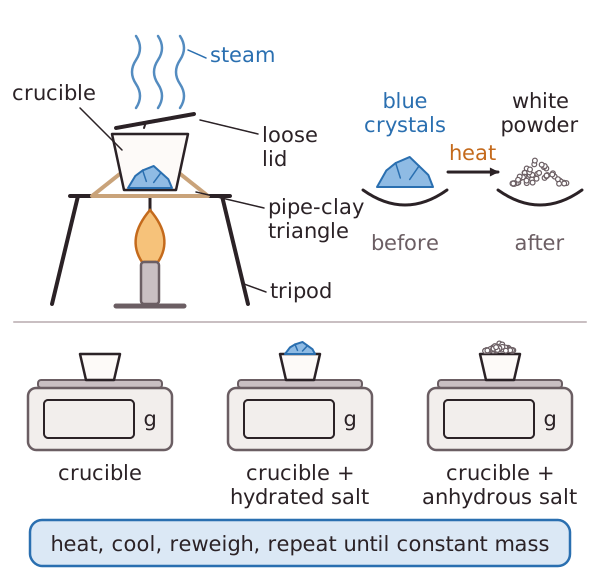 The empirical formula of hydrated copper (II) sulfate, CuSO4.xH2O, can be determined by heating the hydrated salt and measuring the mass of the water and the mass of the anhydrous salt.The number of moles of water for each mole of anhydrous salt gives the value of x.
For example
| mass of the hydrated salt | 9.984g | mass of the anhydrous salt | 6.384g |
| mass of water | 3.600g by subtraction |
Dividing the anhydrous salt and water by their respective relative formula and relative molecular masses gives a molar ratio of 1:5
| CuSO4 | H2O |
| 6.384 159.6 | 3.600 18 |
| 0.04 | 0.2 |
| 1 | 5 |
so x = 5.The crystals are heated to a constant mass (until the mass does not change) to ensure all the water of crystallisation is given off.