Skip to content

Accuracy and Precision

Accuracy and precision describe different qualities of results.A measurement is accurate if it is close to the true value (the accepted value, for example from a data book).A set of repeated measurements is precise if the values are close to each other, so they have a small spread about the mean. Precision says nothing about whether the values are right.The two are independent. Think of darts thrown at a target, where the bullseye is the true value:
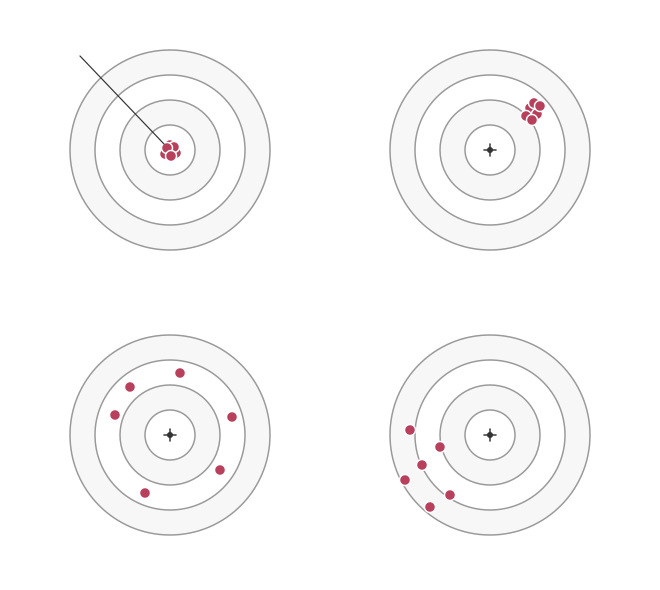
• tightly grouped on the bullseye: accurate and precise• tightly grouped away from the bullseye: precise but not accurate• widely scattered around the bullseye: accurate on average but not precise• widely scattered away from the bullseye: neitherExample: the true titre is 24.00 cm3. A student records 23.10, 23.15 and 23.10 cm3. These are precise (they agree within 0.05 cm3) but not accurate (they are all about 0.9 cm3 too low). Repeating the titration again would not fix this; something in the method is shifting every result the same way.Two related terms are also used. Results are repeatable if the same person with the same method and apparatus gets similar values, and reproducible if different people or methods get similar values.

Read the text

Read the text and highlight anything you think is important. When you go on, the text is hidden and you answer from memory.