A known volume e.g. 150cm3 of water is measured and placed into a beaker.The initial temperature of the water is taken.A known mass of substance is burnt in oxygen and the heat released is used to heat the beaker of water.Fuels such as methanol or ethanol can be placed in a spirit burner. The spirit burner is weighed and then lit. After approximately 3 minutes the flame is extinguished and the spirit burner is re-weighed to determine the mass of fuel burnt.The energy released = m c ΔT
m = mass of water heatedc = specific heat capacity of water 4.18Jg-1°C-1ΔT = temp change of the waterThe density of water is 1gcm-3 so 1cm3 of water has a mass of 1gThe energy calculated can be divided by the number of moles to work out the enthalpy of combustion. The number of moles is the mass ÷ Mr.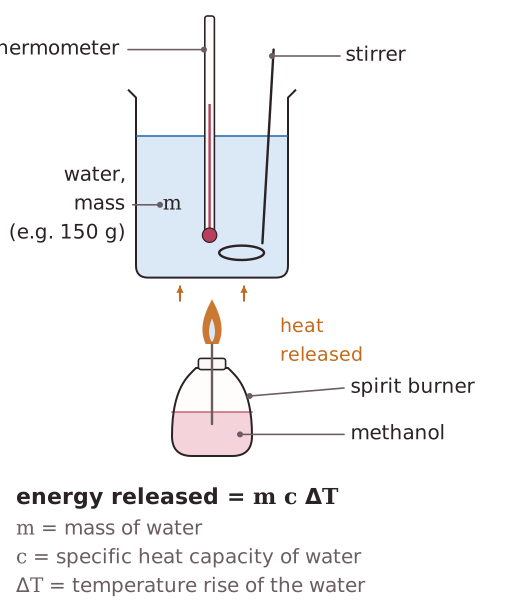
m = mass of water heatedc = specific heat capacity of water 4.18Jg-1°C-1ΔT = temp change of the waterThe density of water is 1gcm-3 so 1cm3 of water has a mass of 1gThe energy calculated can be divided by the number of moles to work out the enthalpy of combustion. The number of moles is the mass ÷ Mr.