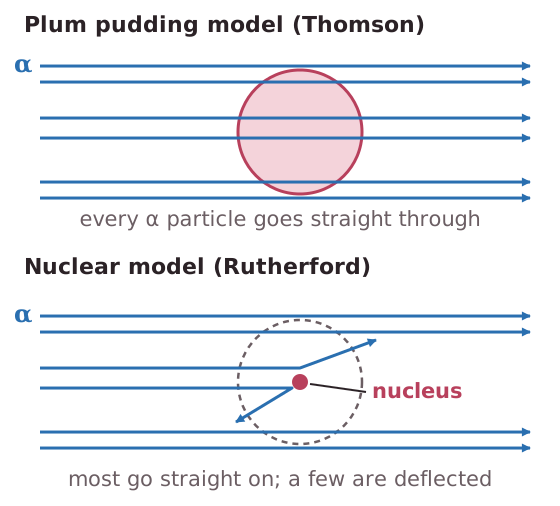
1661 Robert Boyle proposed that some substances could not be made simpler1803 Dalton proposed that elements were made of atoms that could not be divided into smaller components.1896 Becquerel discovered radioactivity and showed particles emitted by atoms.1897 J J Thomson discovered electrons emitted by atoms.1911 Rutherford demonstrated that most of the mass of the atom was concentrated in a small, dense, positive nucleus.
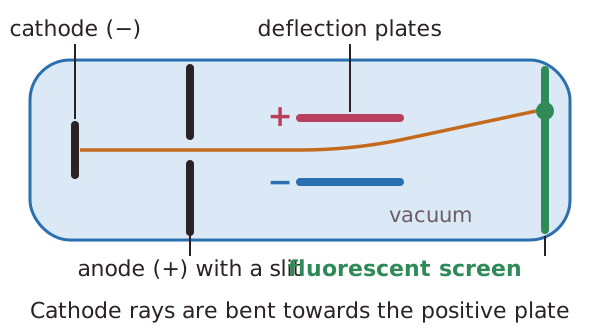
1913 Niels Bohr demonstrated that electrons were arranged in shells around the nucleus.J J Thomson discovered electrons in 1897 after his famous cathode ray experiment.
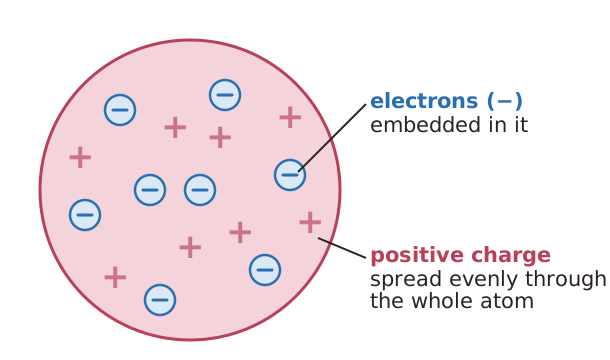
His model is known as the Plum Pudding Model. He proposed that atoms are composed of a sphere with uniformly distributed positive charge with negatively charged electrons embedded within it and electrons held in place by electrostatic attraction to the positive sphere.
Discovery of the Atom
Read the text
Read the text and highlight anything you think is important. When you go on, the text is hidden and you answer from memory.
Specification: AQA Chemistry (7404), AS-level, 3.1.1.1 Fundamental particles. Topic: Atomic Structure.
More in Atomic Structure
- Structure of the Atom
- Relative Mass and Relative Charge
- Atomic Number and Mass Number
- Isotopes
- Isotopes of Carbon
- Electrons
- Electron Shells
- The Mass Spectrometer
All 22 lessons in Atomic Structure · All AQA AS-level Chemistry topics