Because most elements have more than one isotope and naturally occurring elements have different proportions of each isotope, the relative atomic mass is used for calculations involving the mass of atoms. The relative atomic mass is the weighted mean mass of all the isotopes of the atoms of an element compared to one-twelfth the mass of a carbon-12 atom. The relative atomic mass is calculated by adding the products of the mass of the isotopes and their relative frequencies.
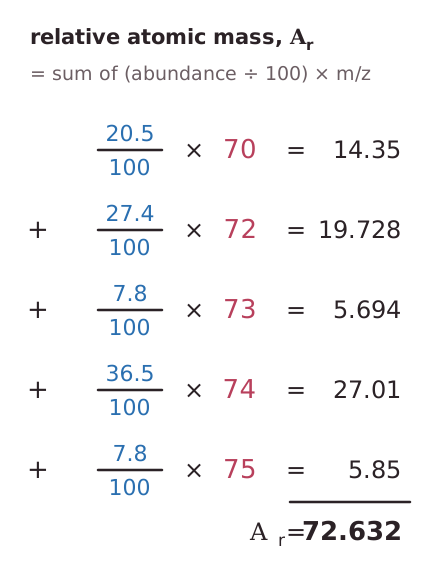
Relative Atomic Mass
Read the text
Read the text and highlight anything you think is important. When you go on, the text is hidden and you answer from memory.
Specification: AQA Chemistry (7404), AS-level, 3.1.2.1 Relative atomic mass and relative molecular mass. Topic: Amount of Substance.
Key terms in this lesson
- Isotopes
- Atoms of the same element with the same number of protons but different numbers of neutrons.
More in Amount of Substance
- Relative Molecular Mass
- Relative Formula Mass
- The Mole and The Avogadro Constant
- Calculating the Number of Moles
- Example Question - 1
- Example Question - 2
- Mass Concentration
- Example Question - 1
All 33 lessons in Amount of Substance · All AQA AS-level Chemistry topics