 BRAINCAKE
Isomerism
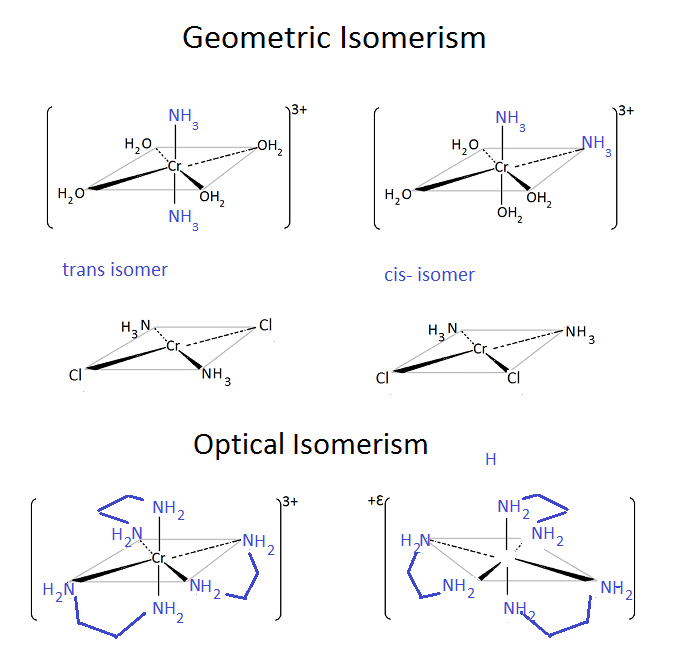
Complex ions exhibit geometric isomerism and optical isomerism. Cis-Trans isomerism occurs if there are two different types of ligand e.g. [Ni(NH3)2Cl2] is a square planar molecule that has both cis- and trans- forms. Geometric isomerism also occurs in octahedral complexes if there are two types of ligands or 2 bidentate ligands with 2 monodentate ligands.
Sign in free to see the rest of this lesson, the R.E.C.I.P.E. recall steps and the quiz
BrainCake is free. Make an account in seconds and pick up where this page stops.
Key terms in this lesson
- complex ion
- A metal ion surrounded by co-ordinately (dative covalently) bonded ligands.
- octahedral complex
- A complex ion with a co-ordination number of six, in which the ligands are arranged symmetrically around the central metal ion.
- bidentate ligand
- A ligand that can donate two pairs of electrons, forming two co-ordinate bonds with the central metal ion.
- monodentate ligand
- A ligand that can donate only one pair of electrons, forming one co-ordinate bond with the central metal ion.
More in Redox Reactions
- Transition Metals
- Properties of Transition Metals
- Complex Ions
- Shapes of complex ions
- Formation of Coloured Ions
- Spectroscopy
- Ligand Substitution Reactions
- Vanadium
All 21 lessons in Redox Reactions · All OCR A-level Chemistry topics