 BRAINCAKE
Formation of Coloured Ions
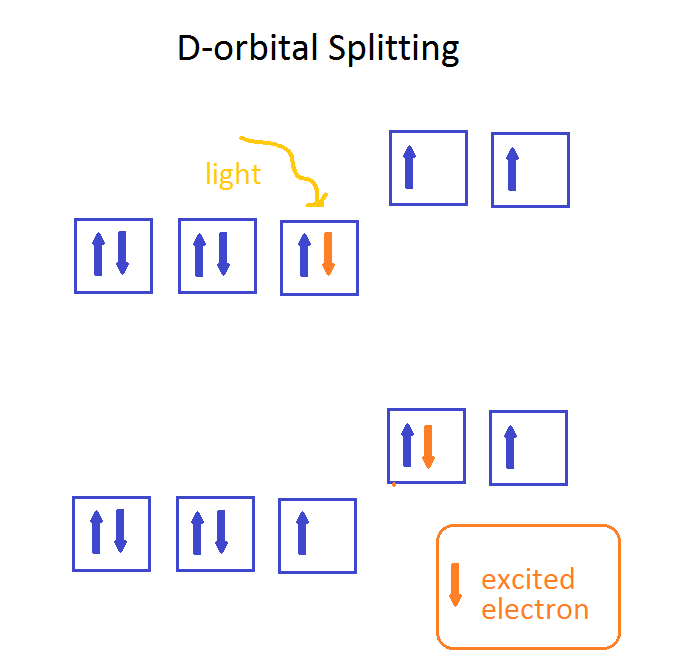
Transition elements with incomplete d subshells have electrons that are initally in the ground state occupying lower energy levels. Usually all five d orbitals have the same energy level. In the presence of a ligand the energy levels split into two higher and three lower or two lower and three higher depending on the ligand. When an electron absorbs a photon of visible light an electron in the lower energy level can be excited and occupy a higher energy orbital.
Sign in free to see the rest of this lesson, the R.E.C.I.P.E. recall steps and the quiz
BrainCake is free. Make an account in seconds and pick up where this page stops.
Key terms in this lesson
- ligand
- An atom, ion or molecule that donates a pair of electrons to a central metal ion to form a co-ordinate bond.
More in Redox Reactions
- Properties of Transition Metals
- Complex Ions
- Shapes of complex ions
- Isomerism
- Spectroscopy
- Ligand Substitution Reactions
- Vanadium
- Tollens Reagent
All 21 lessons in Redox Reactions · All OCR A-level Chemistry topics