Addition polymers are made from monomers with C=C double bonds. The monomer is based on ethene. The double bond opens and the monomers bond together to form a backbone of carbon atoms. There is usually only one monomer but it is possible to have more than one different monomer.Polyalkenes are non-polar and unreactive. As a result they are not attacked by biological agents such as enzymes so are not biodegradable.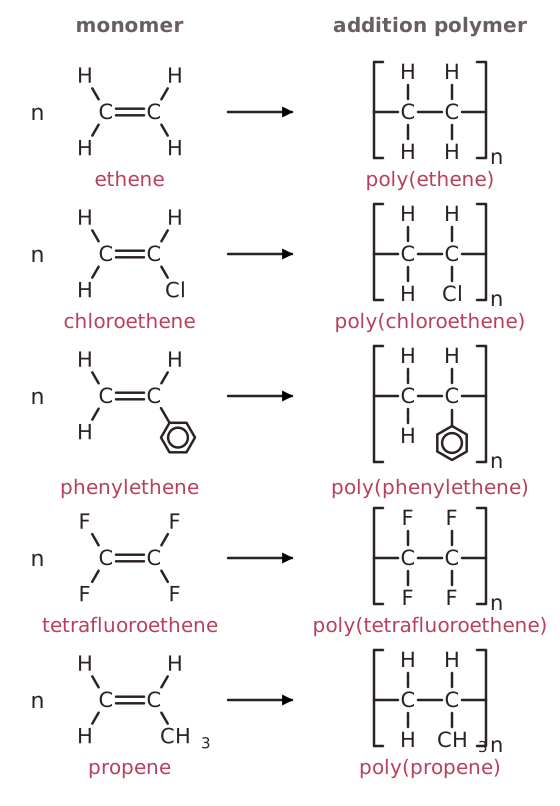
Condensation polymerisation is the joining of two monomers with a small molecule such as water or HCl being eliminated. Condensation polymerisation needs monomers with two functional groups: either two different monomers, each with two of the same functional group (for example a diol and a dicarboxylic acid), or one monomer with two different functional groups (for example an amino acid). Two common condensation polymers are polyesters and polyamides.Addition polymers are usually made from one type of monomer, an alkene, and there is only one product formed. Addition reactions have 100% atom economy.Polyesters and polyamides can be hydrolysed using acid or base hydrolysis. The reaction with hot aqueous hydrochloric acid is much slower than with hot aqueous alkali.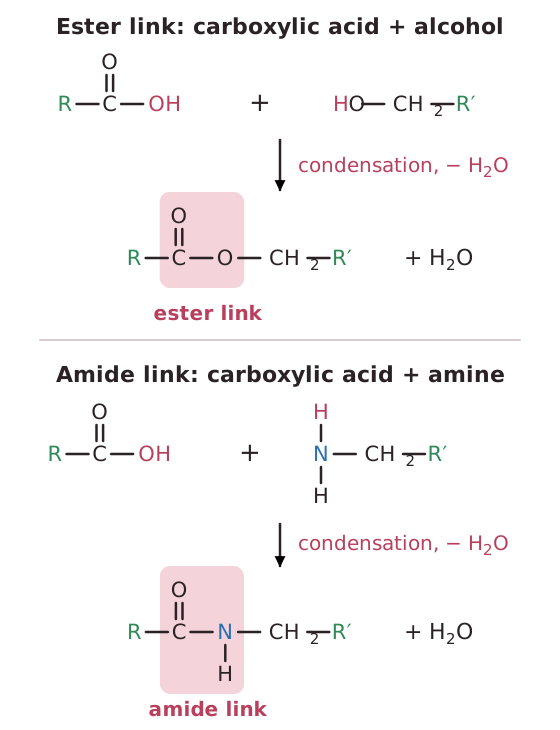
Condensation polymerisation is the joining of two monomers with a small molecule such as water or HCl being eliminated. Condensation polymerisation needs monomers with two functional groups: either two different monomers, each with two of the same functional group (for example a diol and a dicarboxylic acid), or one monomer with two different functional groups (for example an amino acid). Two common condensation polymers are polyesters and polyamides.Addition polymers are usually made from one type of monomer, an alkene, and there is only one product formed. Addition reactions have 100% atom economy.Polyesters and polyamides can be hydrolysed using acid or base hydrolysis. The reaction with hot aqueous hydrochloric acid is much slower than with hot aqueous alkali.