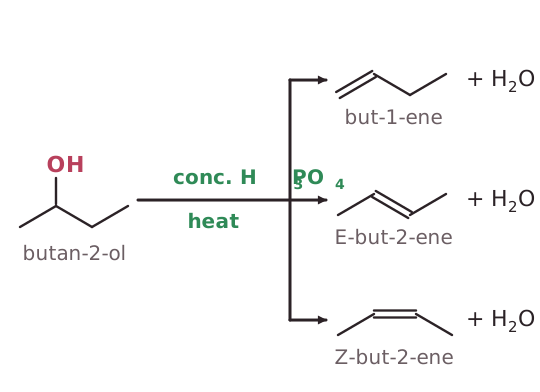
On heating an alcohol with concentrated phosphoric acid H3PO4, an elimination reaction occurs. A molecule of water is eliminated and an alkene is formed. This reaction is also known as dehydration.For some alcohols with more than three carbon atoms, there may be more than one possible product due to the positional isomerism of the double bond forming between different carbon atoms, and E-Z isomerism due to the presence of a double bond.The dehydration of butan-2-ol is as follows:CH3CH(OH)CH2CH3 → CH2=CHCH2CH3 + H2OCH3CH(OH)CH2CH3 → CH3CH=CHCH3 + H2O