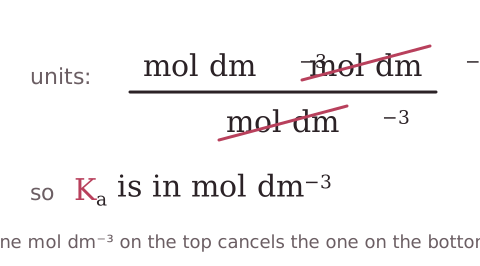
A weak acid has the following equilibrium in aqueous solution:HA (aq) ⇌ H+(aq) + A-(aq)The expression for the acid dissociation constant is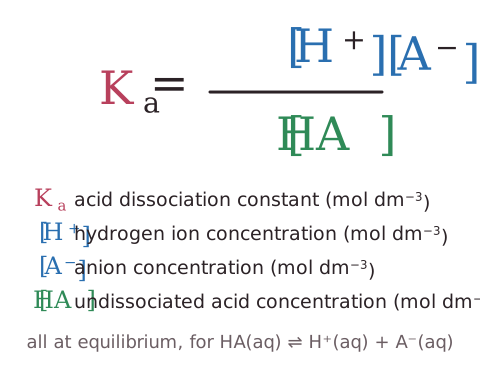 The units can be found by substituting units for the concentrations
 Written out, the expression for a weak acid HA is
Ka = [H+(aq)][A-(aq)] / [HA(aq)] Substituting units gives (mol dm-3 × mol dm-3) / mol dm-3, so the units of Ka are mol dm-3.Ka measures the extent to which a weak acid dissociates. A larger Ka means the equilibrium lies further to the right, more H+ ions are released and the acid is stronger. For example, methanoic acid (Ka = 1.6 × 10⁻⁴ mol dm-3) is a stronger acid than ethanoic acid (Ka = 1.7 × 10⁻⁵ mol dm-3).Strong acids such as hydrochloric acid dissociate completely, so Ka is not used for them. Like every equilibrium constant, Ka changes only with temperature.Because Ka values are often very small, they are frequently converted to pKa:pKa = -log10Ka The smaller the pKa, the stronger the acid.
The units can be found by substituting units for the concentrationsWritten out, the expression for a weak acid HA is