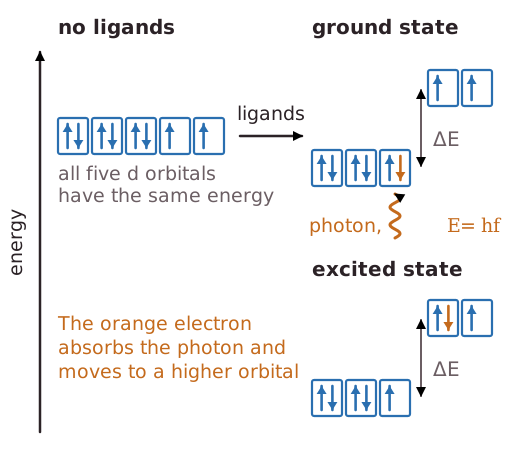
Transition elements with incomplete d subshells have electrons that are initially in the ground state occupying lower energy levels. Usually all five d orbitals have the same energy level. In the presence of a ligand the energy levels split into two higher and three lower or two lower and three higher depending on the ligand. When an electron absorbs a photon of visible light an electron in the lower energy level can be excited and occupy a higher energy orbital.The energy absorbed E = hf where h is the Planck constant and f is the frequency of the photon. The frequencies absorbed depend on the size of the energy gap and the frequencies not absorbed are transmitted. The colour of the ion is the transmitted frequencies combined.