Ammonia, primary aliphatic amines and primary aromatic amines are all bases, but they differ in strength. Base strength depends on how available the lone pair on the nitrogen is to accept a proton. The more electron density on the nitrogen, the more strongly the lone pair attracts H+ and the stronger the base.Primary aliphatic amines are stronger bases than ammonia. Alkyl groups have a positive inductive effect: they release electrons towards the nitrogen. This increases the electron density on the nitrogen, so its lone pair is more available. For example, ethylamine is a stronger base than ammonia.Primary aromatic amines are weaker bases than ammonia. In phenylamine, C6H5NH2, the lone pair on the nitrogen overlaps with the delocalised π electrons of the benzene ring. The lone pair is partly delocalised into the ring, which lowers the electron density on the nitrogen. The lone pair is less available, so phenylamine is a weaker base than ammonia.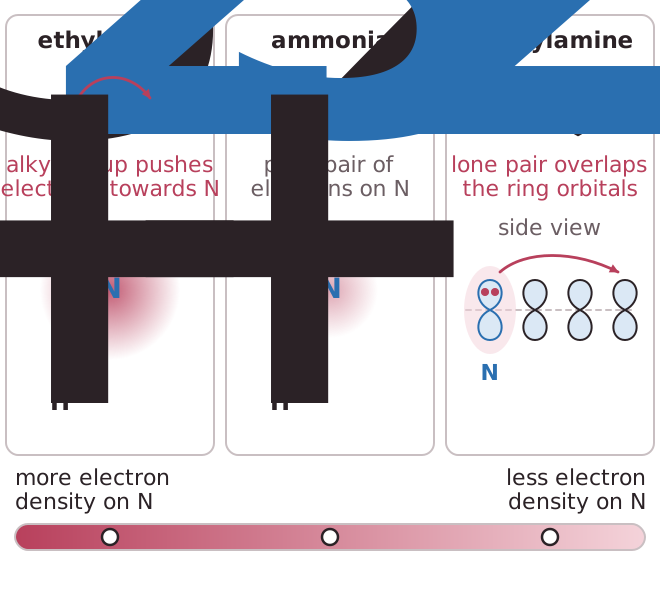 Order of base strength:
primary aliphatic amine > ammonia > primary aromatic amine Worked example: put propylamine, ammonia and phenylamine in order, strongest base first. Propylamine has an electron-releasing propyl group, so it is strongest. Phenylamine's lone pair is delocalised into the ring, so it is weakest. Order: propylamine > ammonia > phenylamine.In exams, always explain in terms of the lone pair on nitrogen and how available it is, not just by stating the order.
Order of base strength: