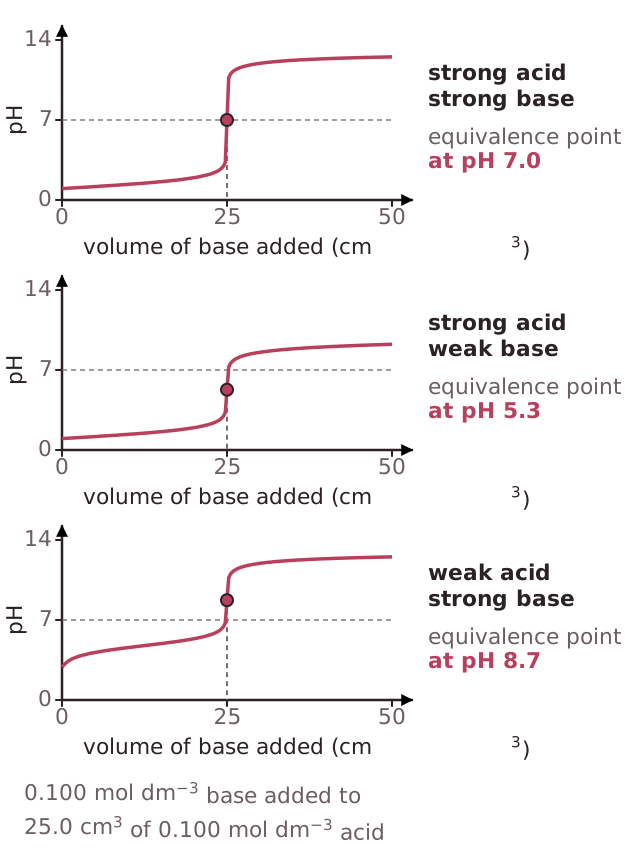
In a titration, you measure the volume of the solution in the burette that is needed to react exactly with the solution in the conical flask. This is known as the equivalence point. Acid-base titration can be carried out and the pH can be plotted as the reaction progresses. The pH can be measured using a pH meter and data logger connected to a computer. Considering an acid-base titration with an alkali such as sodium hydroxide added to a strong acid such as hydrochloric acid. When the base is first added, the pH increases only slightly because the acid is in excess. This is because the acid is in large excess, and as pH is a logarithmic scale, removing some of the H+ ions changes the pH very little. Within 1 - 2 cm3 of the equivalence point, the pH starts to increase rapidly. There is only a small amount of acid left, so with the addition of a tiny amount of alkali, the solution is neutralised and there is a very sharp increase in pH.As more base is added, there is little change in pH as the solution is now just basic as all the acid has reacted.