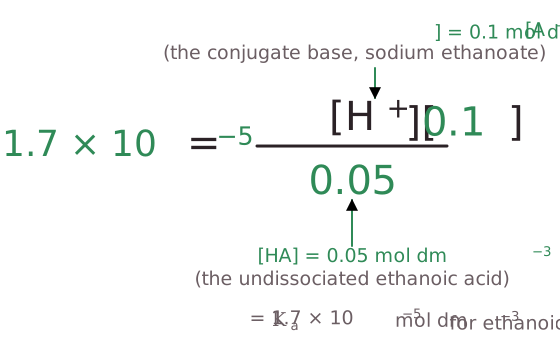
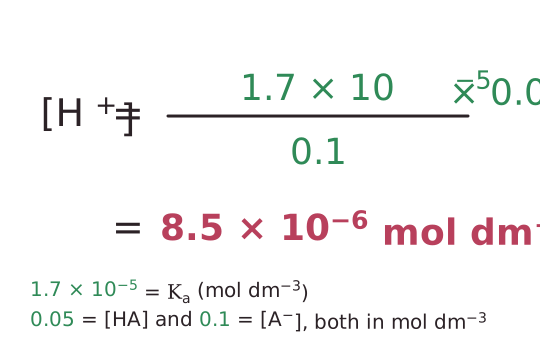
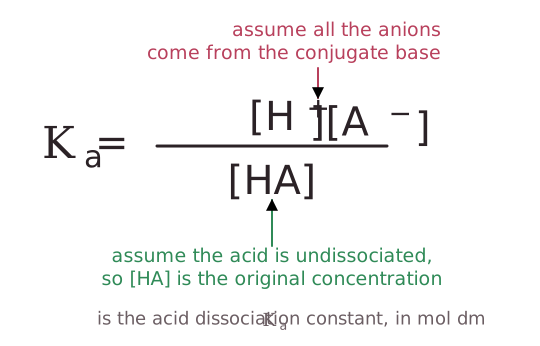
To find the pH of any solution, you need to determine the hydrogen ions concentration. Most of the acid is undissociated so [HA] can be assumed to be the original (undissociated) acid concentration. Most of the anion comes from the conjugate base which dissociates completely. Very little is from the undissociated acid. So the anion concentration is assumed to be the original conjugate base concentration.A buffer solution made by adding 50cm3 of 0.100moldm-3 ethanoic acid to 50 cm3 of 0.200 moldm-3 sodium ethanoate. When the solutions are added together the concentrations will halve. Ka for ethanoic acid is 1.7 x 10⁻⁵ moldm-3. Substituting the concentrations to find the hydrogen ion concentration: