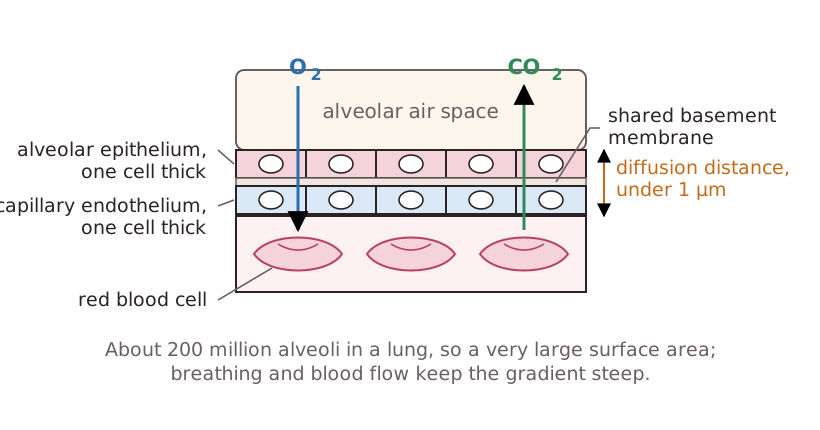
The rate of diffusion is proportional to the surface area and the diffusion gradient and inversely proportional to the diffusion distance.Ventilation (inspiration) refreshes the lungs and brings in more oxygen into the lungs. Blood flow removes the oxygen that has diffused from the lungs into the capillary. This maintains the steep concentration gradient.The walls of the capillaries and the walls of the alveoli are very thin. This ensures a short diffusion distance.The numerous alveoli and capillaries collectively have a large surface area. The total surface area of the alveoli is about 70m2.Elastic recoil is the rebound of the lungs after having been stretched by inhalation.Elastin in the elastic fibres in the connective tissue of the lungs and the surface tension of the film of fluid that lines the alveoli facilitate elastic recoil.Surfactant is a lipoprotein formed by alveolar cells.The proteins and lipids that comprise surfactant have both a hydrophilic region and a hydrophobic region. The hydrophilic head groups are in the water and the hydrophobic tails facing towards the air reduces surface tension preventing the collapsing of the lungs.