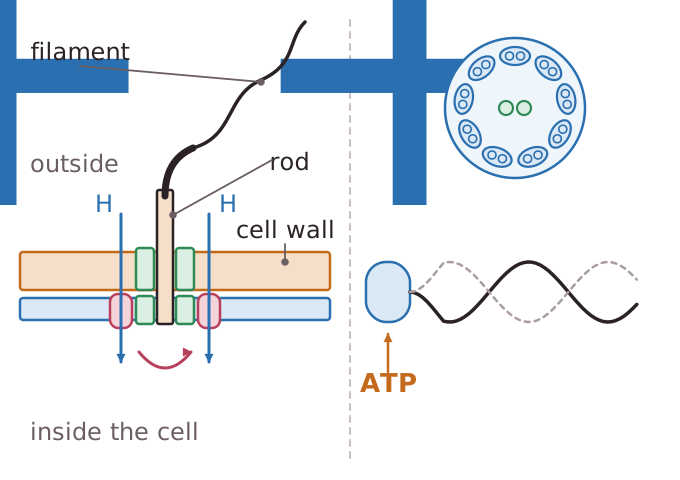
The flagella of eukaryotes is made of microtubules with a 9+2 arrangement. Microtubules are assembled from a protein called tubulin.Most motile bacteria move by means of flagella.The flagella of prokaryotes are simpler and thinner filaments made from a protein called flagellin. The flagella do not have a 9+2 arrangement.The flagella is attached to the cell membrane via a hook connected to a basal body in the membrane. The hook is rotated by a molecular motor giving the filament a whip-like movement which propels the bacterium forward.The energy to move the flagella in eukaryotes is from ATP. The energy to rotate the filament that forms the flagella in prokaryotes is derived from chemiosmosis.
Read the text
Read the text and highlight anything you think is important. When you go on, the text is hidden and you answer from memory.
Specification: OCR Biology A (H020), AS-level, 2.1.1 Cell structure. Topic: Cell Structure.
Key terms in this lesson
- prokaryotic cell
- A cell with no nucleus or membrane-bound organelles, found in bacteria.
- eukaryotic cell
- A cell with a nucleus and membrane-bound organelles, found in animals, plants, fungi and protoctists.
- ATP
- Adenosine triphosphate, a nucleotide that acts as the immediate energy source of a cell, releasing energy when hydrolysed to ADP and inorganic phosphate.
More in Cell Structure
- Vacuole
- Chloroplasts
- Prokaryotic Cells
- DNA
- Ribosomes
- Cell Wall
- The Theory of Endosymbiosis
- Comparison with Eukaryotic Cells
All 26 lessons in Cell Structure · All OCR AS-level Biology topics