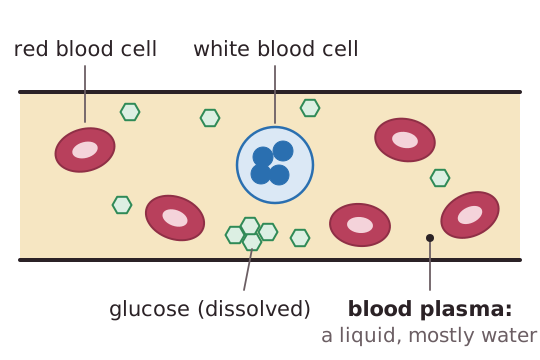
Water is a polar solvent because water molecules have partial charges.Water can therefore act as a solvent for many molecules needed for cellular functions.The cytosols of both prokaryotic and eukaryotic cells are mainly water. Water dissolves amino-acids, proteins, simple sugars and many molecules helps transport dissolved substances in and out of cells.Blood plasma is mostly water. It transports substances such as glucose and cells such as red blood cells and white blood cells around the body as it is a liquid at body temperature.Water is also used in the phloem to transport dissolved sucrose made in photosynthesis around plants.
Water as a Solvent
Read the text
Read the text and highlight anything you think is important. When you go on, the text is hidden and you answer from memory.
Specification: OCR Biology A (H020), AS-level, 2.1.2 Biological molecules. Topic: Biological Molecules.
Key terms in this lesson
- prokaryotic cell
- A cell with no nucleus or membrane-bound organelles, found in bacteria.
- eukaryotic cell
- A cell with a nucleus and membrane-bound organelles, found in animals, plants, fungi and protoctists.
More in Biological Molecules
- Hydrogen Bonding and Boiling Point of Water
- Density of Water
- Cohesion, Adhesion and Surface Tension
- Specific Heat Capacity of Water
- Carbohydrates
- Glucose
- Other Monosaccharides
- Condensation Reactions
All 63 lessons in Biological Molecules · All OCR AS-level Biology topics