Skip to content

Bonding

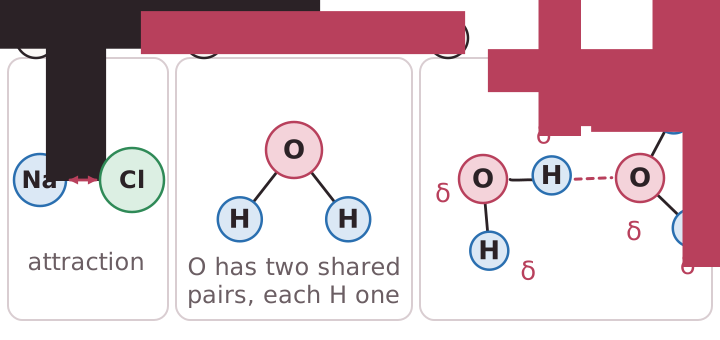
The atoms in organic compounds are held together by strong covalent bonds.A covalent bond is formed when two atoms share a pair of electrons.Carbon forms four covalent bonds, nitrogen forms three covalent bonds, oxygen forms two covalent bonds and hydrogen forms one.Intermolecular bonds are bonds between molecules and they are weaker than covalent bonds. Hydrogen bonding occurs widely in nature and is the strongest type of intermolecular bond.Ionic bonding occurs between oppositely charged ions and oppositely charged groups on organic molecules such as NH3+ and COO-.
Read the text

Read the text and highlight anything you think is important. When you go on, the text is hidden and you answer from memory.

Specification: OCR Biology A (H020), AS-level, 2.1.2 Biological molecules. Topic: Biological Molecules.

Key terms in this lesson

hydrogen bond
A weak intermolecular attraction between a slightly positive hydrogen atom on one molecule and a slightly negative atom, such as oxygen or nitrogen, on another.

More in Biological Molecules

All 63 lessons in Biological Molecules · All OCR AS-level Biology topics