Living animals can be collected for later study. All animals should be handled carefully and for a short time only.Animals should be released back into the habitat as soon as all the data has been obtained.A pooter is a device used to capture small insects. Sucking on a mouthpiece draws up the insects through an inlet tube into a holding chamber. A filter between the mouthpiece and chamber stops the insects from entering the mouth.Where the grass is long, sweep nets can be used to sweep up the insects.Pitfall traps can be used to catch small crawling invertebrates. This consists of a hole dug into the ground into which insects and crawling invertebrates can fall.It is deep enough for them not to be able to crawl out again and it is covered with a roof so it does not fill with water. The traps can be left overnight for nocturnal insects.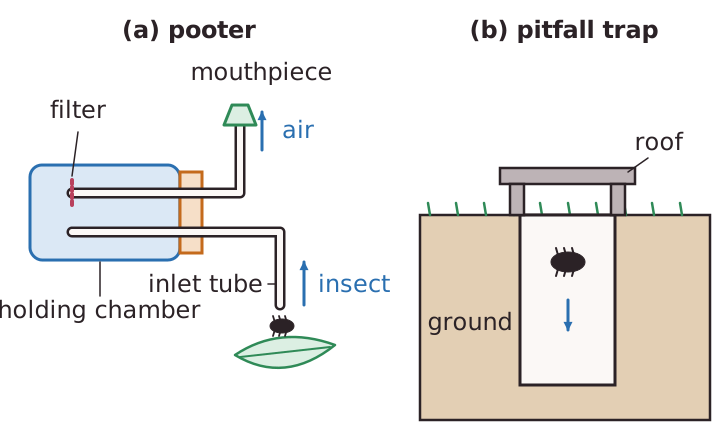 A sheet can be placed under a tree and the tree shaken or beaten to dislodge invertebrates onto the sheet.In a river, kick sampling is used.The river bed is kicked for a period of time to disturb the substrate and a net captures any organism released into the flowing water.Quadrats can be used to sample slow-moving animals such as limpets, barnacles or mussels.