In random sampling, each individual in the population has an equal chance of being selected.Random number tables, calculators or computers can be used to generate random numbers.To make a random sample of a field, a grid is marked out on the field using two tape measures.The x and y co-ordinates are generated using a random number generator and the quadrat is placed at the intersection of the two co-ordinates.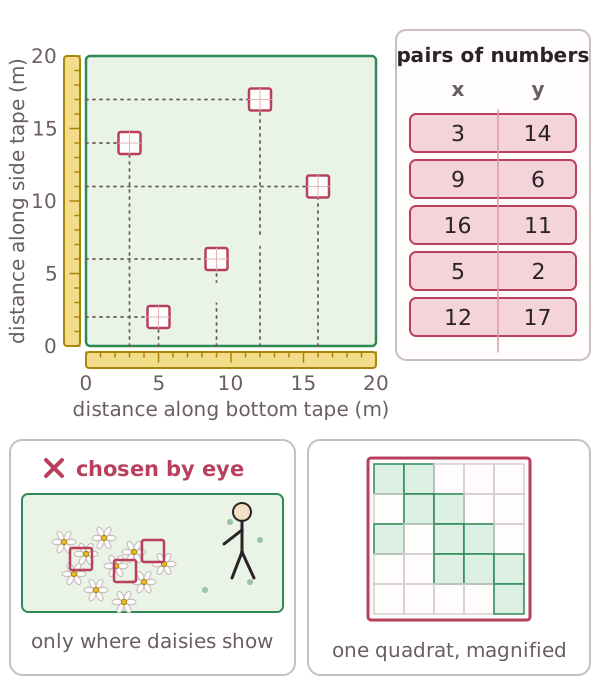 Measurements and observations are taken of the area enclosed by the quadrat.Simple random sampling is a basic type of sampling and can be a component of other more complex sampling methods.In small populations and often in large ones, such sampling is typically done without replacement so any member of the population cannot be chosen more than once.Sampling done without replacement is no longer independent, but still satisfies exchangeability, hence most results of mathematical statistics still hold. Further, for a small sample from a large population, sampling without replacement is approximately the same as sampling with replacement, since the probability of choosing the same individual twice is low.