 BRAINCAKE
Arterial End of Capillaries
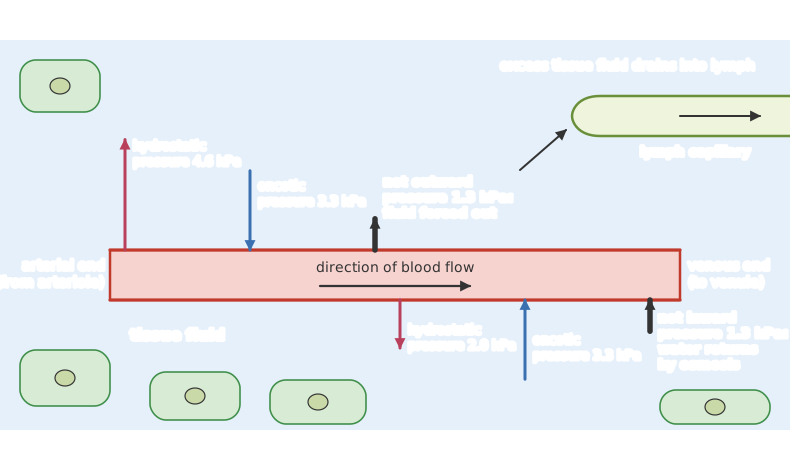
Whether fluid leaves a capillary depends on the balance between two opposing pressures: hydrostatic pressure, which pushes fluid out, and oncotic pressure, which draws water back in.
At the arterial end of a capillary, the blood has just come from an arteriole, so its hydrostatic pressure is high. Here the hydrostatic pressure is greater than the oncotic pressure. The difference between them is the net outward pressure, and it forces fluid out of the capillary through the gaps between the endothelial cells. This is called pressure filtration.
Sign in free to see the rest of this lesson, the R.E.C.I.P.E. recall steps and the quiz
BrainCake is free. Make an account in seconds and pick up where this page stops.
Key terms in this lesson
- hydrostatic pressure
- The pressure a fluid exerts on the walls of its container; in a capillary it pushes fluid out through the gaps between the endothelial cells.
- oncotic pressure
- The pressure created by plasma proteins, which are too large to leave the capillaries, that draws water back into the capillaries by osmosis.
More in Circulatory Systems
- Capillaries
- Veins and venules
- Tissue Fluid
- Oncotic Pressure
- Hydrostatic Pressure
- Venous End of Capillaries
- Formation of Lymph
- Lymph Nodes
All 33 lessons in Circulatory Systems · All Edexcel AS-level Biology topics