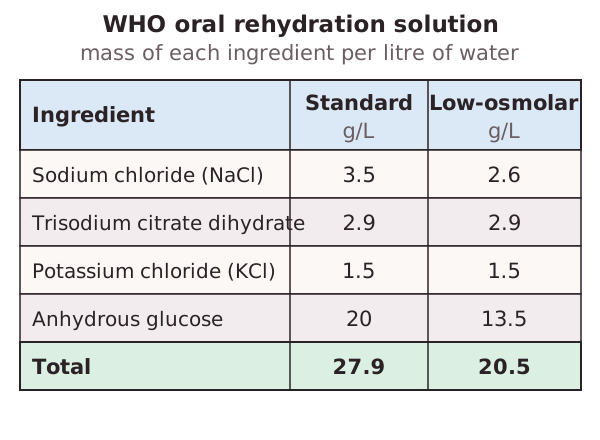
Diseases like typhoid or cholera infect the intestines and cause diarrhoea.The frequent production of watery faeces results in excessive fluid being lost from the body as not enough water is reabsorbed by the large intestine.This can lead to death, especially in the very young.Diarrhoea may be caused by damage to the epithelial cells, loss of microvilli due to toxins or a decrease in the water potential in the lumen due to toxins such as cholera toxin.Treatment is by oral rehydration therapy. Water and electrolytes are replaced by a drip or a rehydration solution containing glucose, sodium, potassium and other electrolytes.Sodium ions are absorbed by alternative pathways and alternative sodium-glucose carrier proteins are used.
Oral Rehydration Therapy
Read the text
Read the text and highlight anything you think is important. When you go on, the text is hidden and you answer from memory.
Specification: AQA Biology (7401), AS-level, 3.2.3 Transport across cell membranes. Topic: Transport Across Cell Membranes.
Key terms in this lesson
- water potential
- The pressure created by water molecules, a measure of the tendency of water to move out of a solution; pure water has a water potential of zero and solutes make it more negative.
More in Transport Across Cell Membranes
- Osmosis
- Osmosis in Animal Cells
- Osmosis in Plant Cells
- Active Transport
- Sodium-Potassium Pump
- Increasing the Rate of Movement across a Membrane
- Absorption in the Ileum
- Co-transport in Absorption
All 22 lessons in Transport Across Cell Membranes · All AQA AS-level Biology topics