 BRAINCAKE
Phloem Loading
Active phloem loading uses the apoplast pathway and uses energy and membrane-bound co-transporter protein and a proton pump to move sucrose into the sieve tubes.
Passive phloem loading transports sucrose freely through plasmodesma in the symplast pathway.
Apoplast Pathway
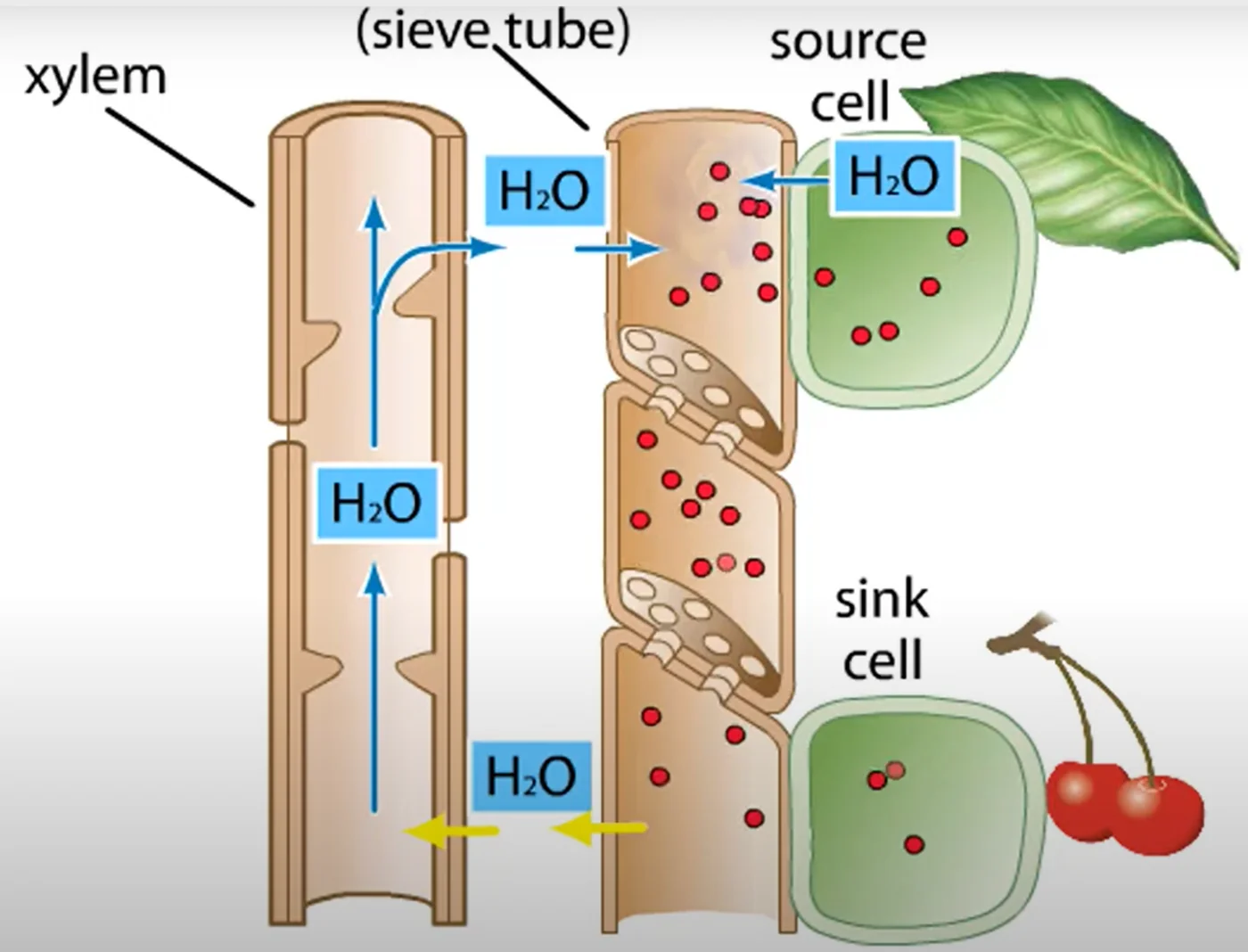
Sign in free to see the rest of this lesson, the R.E.C.I.P.E. recall steps and the quiz
BrainCake is free. Make an account in seconds and pick up where this page stops.
Key terms in this lesson
- ATP
- Adenosine triphosphate, a nucleotide that acts as the immediate energy source in cells, releasing energy when hydrolysed to ADP and phosphate.
- diffusion
- The net passive movement of molecules or ions from a region of higher concentration to a region of lower concentration, down a concentration gradient.
- facilitated diffusion
- The passive movement of molecules or ions down their concentration gradient through protein channels or carrier proteins.
- co-transport
- The movement of one molecule or ion across a membrane, using a carrier protein, coupled to the facilitated diffusion of another down its concentration gradient.
- phloem
- Plant vascular tissue, made of sieve tube elements and companion cells, that transports organic solutes such as sucrose around the plant.
More in Mass Transport in Plants
- Movement of Water Up the Stem
- Movement of Water Across the Leaf
- Movement of Water Through the Stomata
- Translocation
- Mass Flow through Sieve Tube Elements
- Mass Flow Model
- Phloem Unloading
- Ringing Experiments
All 15 lessons in Mass Transport in Plants · All AQA AS-level Biology topics