 BRAINCAKE
Mass Flow through Sieve Tube Elements
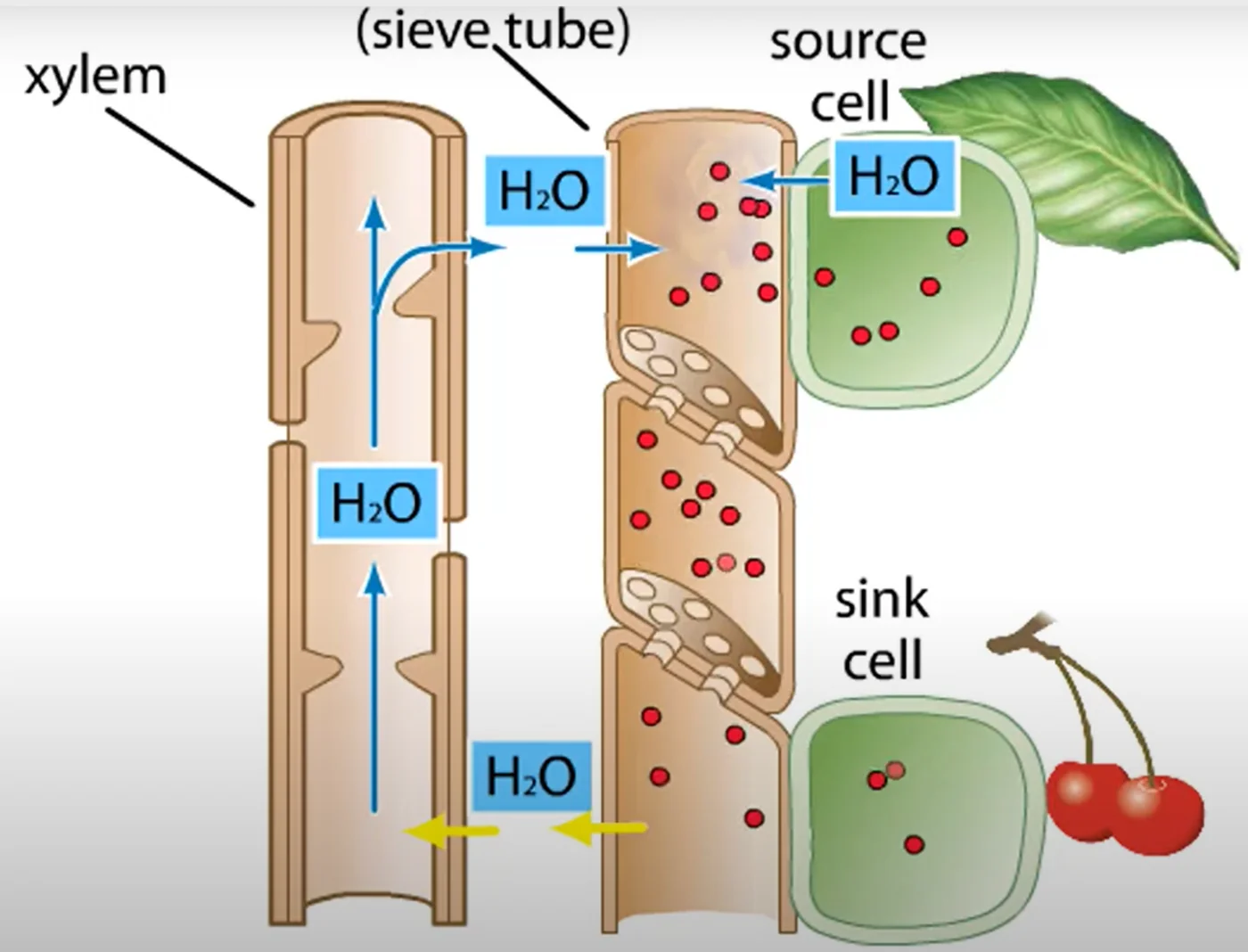
Sucrose loaded into the sieve tubes causes the sieve tubes to have a lower water potential.
Water moves from xylem vessels into the sieve tubes down the water potential gradient by osmosis.
Sign in free to see the rest of this lesson, the R.E.C.I.P.E. recall steps and the quiz
BrainCake is free. Make an account in seconds and pick up where this page stops.
Key terms in this lesson
- osmosis
- The net movement of water molecules from a region of higher water potential to a region of lower water potential through a selectively permeable membrane.
- water potential
- The pressure created by water molecules, a measure of the tendency of water to move out of a solution; pure water has a water potential of zero and solutes make it more negative.
- active transport
- The movement of molecules or ions across a membrane from a region of lower to higher concentration, against the concentration gradient, using ATP and carrier proteins.
- xylem
- Plant vascular tissue, made of dead, lignified tubular cells, that transports water and mineral ions from the roots to the leaves.
More in Mass Transport in Plants
- Movement of Water Across the Leaf
- Movement of Water Through the Stomata
- Translocation
- Phloem Loading
- Mass Flow Model
- Phloem Unloading
- Ringing Experiments
- Tracer Experiments
All 15 lessons in Mass Transport in Plants · All AQA AS-level Biology topics