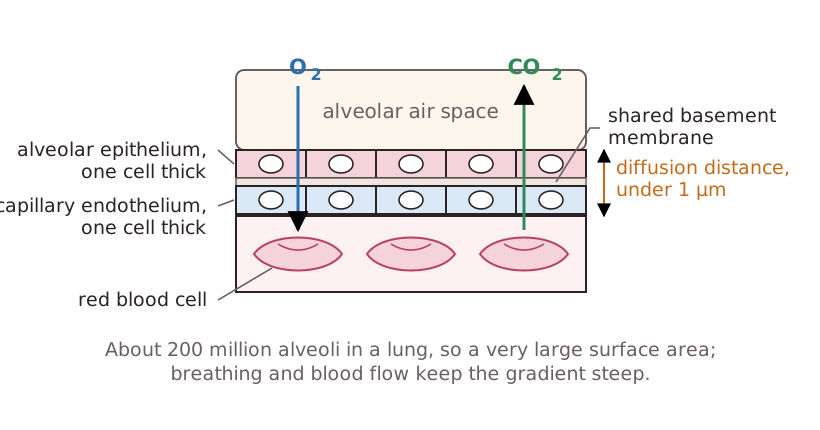
Alveoli are the specialised gas exchange surface in the lungs.They are thin, blindly ending air sacs 100-300 μm in diameter. There are about 200 million per lung.They are thin and delicate and easily damaged so are located inside the body for protection.Each alveolus is made of epithelial cells 0.05 to 0.3μm thick.The alveoli are able to stretch when filled with air and recoil to expel air.Each alveolus is surrounded by a network of capillaries. The capillary walls are only one cell thick and just wide enough for a red blood cell to squeeze through.Collectively they have a large surface area for diffusion of oxygen into the body and diffusion of carbon dioxide out of the body.
Read the text
Read the text and highlight anything you think is important. When you go on, the text is hidden and you answer from memory.
Specification: AQA Biology (7401), AS-level, 3.3.2 Gas exchange and 3.3.1 Surface area to volume ratio. Topic: Exchange of Gases.
Key terms in this lesson
- diffusion
- The net passive movement of molecules or ions from a region of higher concentration to a region of lower concentration, down a concentration gradient.
More in Exchange of Gases
- The Lungs
- Mechanism of Breathing
- Inspiration
- Expiration
- Role of Alveoli in Gas Exchange
- Correlation and Causation
- Risk Factors for Lung Disease
- Smoking and Lung Cancer
All 28 lessons in Exchange of Gases · All AQA AS-level Biology topics