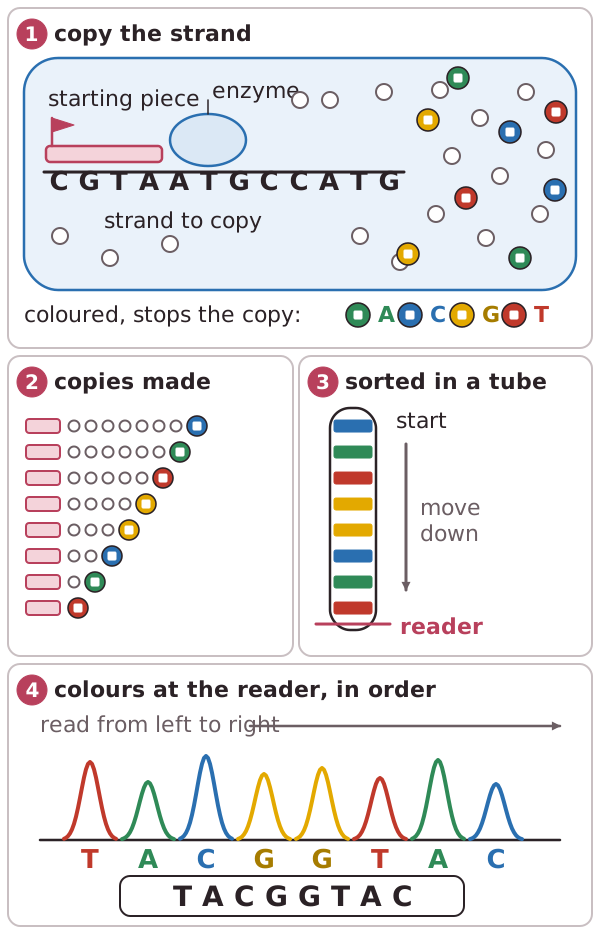
DNA sequencing can now be done by machines so base sequences can be compared to establish relationships between species.The Sanger method is used to sequence DNA fragments.Modified nucleotides which can attach to a base but are terminators are used.Each of them has a different coloured fluorescent tag attached.A mixture of the single stranded DNA fragments to be sequenced, nucleotides and a small quantity of one of the terminator nucleotides, radioactively or fluorescently labelled primer to start DNA synthesis, DNA polymerase for DNA synthesis are placed in an automated DNA sequencer.The terminator nucleotides are added at random so there will be DNA of different lengths synthesised.The fragments can be separated by electrophoresis.By arranging the DNA fragments in order of length and determining the terminator bases, the base sequence can be determined.
Comparing DNA
Read the text
Read the text and highlight anything you think is important. When you go on, the text is hidden and you answer from memory.
Specification: AQA Biology (7401), AS-level, 3.4.7 Investigating diversity. Topic: Biodiversity.
Key terms in this lesson
- nucleotide
- A molecule made of a pentose sugar, a phosphate group and a nitrogen-containing base.
- DNA polymerase
- The enzyme that joins free nucleotides together to form a new complementary strand of DNA.
- species
- A group of organisms with similar characteristics that can interbreed to produce fertile offspring.
More in Biodiversity
- The Impact of Agriculture
- Balancing Conservation and Farming
- Managing Ecosystems
- Investigating Diversity
- Comparing mRNA
- Comparing Amino-acids Sequences
- Sampling
- Random Sampling
All 33 lessons in Biodiversity · All AQA AS-level Biology topics