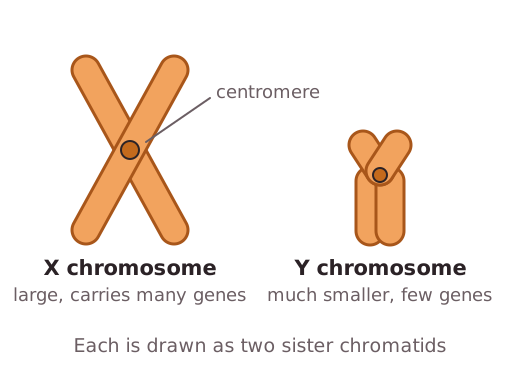
In humans, there are 23 pairs of homologous chromosomes. 22 pairs are called autosomes and there is a pair of sex chromosomes. Females have two X chromosomes and males have an X and a Y chromosome. The Y chromosome has few genes. All mammals would develop as females in the absence of the genes on the Y chromosome which stimulate primary sexual development in the embryo.As females are XX and have two X chromosomes (the homogametic sex) if there is a faulty gene on one of the X chromosomes this will be masked by a functioning gene on the other as long as the allele is recessive. As males only have one X chromosome and are XY (the heterogametic sex) any faulty genes on the X chromosome will not be masked.
Sex Linkage
Read the text
Read the text and highlight anything you think is important. When you go on, the text is hidden and you answer from memory.
Specification: OCR Biology A (H420), A-level, 6.1.2 Patterns of inheritance. Topic: Genetics and Variation.
Key terms in this lesson
- Allele
- One of the different forms of a gene, arising from mutation, that occupies the same locus on homologous chromosomes.
- Linkage
- The tendency of genes located close together on the same chromosome to be inherited together rather than assorting independently.
More in Genetics and Variation
- Body Mass
- Genetic Variation
- Continuous and Discontinuous Variation
- Genetic Cross
- Dihybrid Crosses
- Linkage
- Χ-squared Test
- Epistasis
All 41 lessons in Genetics and Variation · All OCR A-level Biology topics