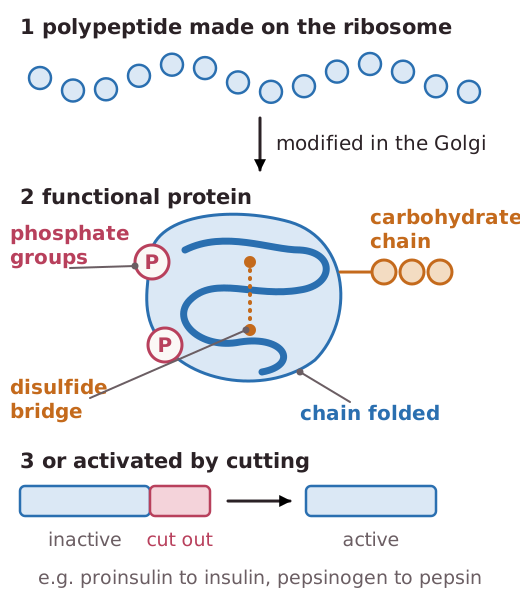
Post-translational control regulates the activity of a protein after it has been made on the ribosome. The polypeptide produced by translation often has to be modified before it becomes functional, which gives the cell another point at which gene expression can be controlled.Many modifications take place in the Golgi apparatus. Non-protein groups can be added, such as carbohydrate chains to form glycoproteins, lipids to form lipoproteins, or phosphate groups. Amino acids can be modified, the chain is folded, and disulfide bridges can form to hold the protein in its tertiary or quaternary structure.Some proteins are made as inactive precursors and are activated by removing part of the chain. For example, insulin is made as proinsulin and a section is cut out to give the active hormone, and the enzyme pepsin is secreted as inactive pepsinogen.Proteins can also be activated by cyclic AMP (cAMP). When a hormone such as adrenaline binds to a receptor on the cell surface membrane, the enzyme adenylyl cyclase is activated and converts ATP into cAMP. The cAMP binds to protein kinase A and activates it.Protein kinase A then phosphorylates other proteins. Adding a phosphate group changes their tertiary structure, which switches them on or off. This lets a cell change its activity very quickly without making new proteins.