A trophic level is the position an organism occupies in a food chain, that is, its feeding level.• Trophic level 1: producers
• Trophic level 2: primary consumers
• Trophic level 3: secondary consumers
• Trophic level 4: tertiary consumersFor example, in: phytoplankton → zooplankton → small fish → seal → killer whale, the seal is at trophic level 4 and the killer whale at trophic level 5.In a food web an organism can feed at more than one trophic level. A human eating a salad is at trophic level 2; the same human eating a tuna steak may be at trophic level 4 or higher.Why food chains are short
At each step along a food chain, only a small fraction of the biomass (and energy) in one trophic level is passed to the next. The rest is lost, mainly through respiration as heat and in parts that are not eaten or not digested. After four or five transfers there is too little biomass left to support another population of consumers, so most food chains have no more than four or five trophic levels.Pyramids
The amounts at each trophic level can be drawn as a pyramid, with producers at the bottom. A pyramid of numbers shows how many organisms are at each level. It can be an odd shape: one oak tree supports thousands of caterpillars. Pyramids of biomass and energy avoid this problem, and are covered in the next lesson.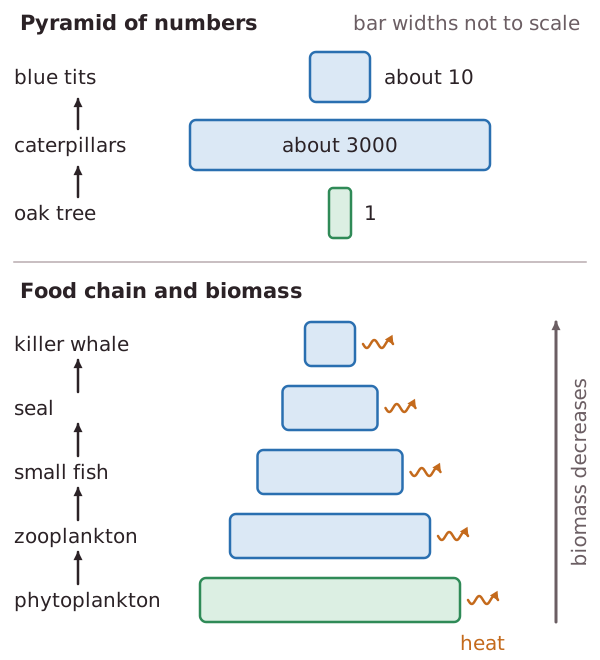
• Trophic level 2: primary consumers
• Trophic level 3: secondary consumers
• Trophic level 4: tertiary consumersFor example, in: phytoplankton → zooplankton → small fish → seal → killer whale, the seal is at trophic level 4 and the killer whale at trophic level 5.In a food web an organism can feed at more than one trophic level. A human eating a salad is at trophic level 2; the same human eating a tuna steak may be at trophic level 4 or higher.Why food chains are short
At each step along a food chain, only a small fraction of the biomass (and energy) in one trophic level is passed to the next. The rest is lost, mainly through respiration as heat and in parts that are not eaten or not digested. After four or five transfers there is too little biomass left to support another population of consumers, so most food chains have no more than four or five trophic levels.Pyramids
The amounts at each trophic level can be drawn as a pyramid, with producers at the bottom. A pyramid of numbers shows how many organisms are at each level. It can be an odd shape: one oak tree supports thousands of caterpillars. Pyramids of biomass and energy avoid this problem, and are covered in the next lesson.