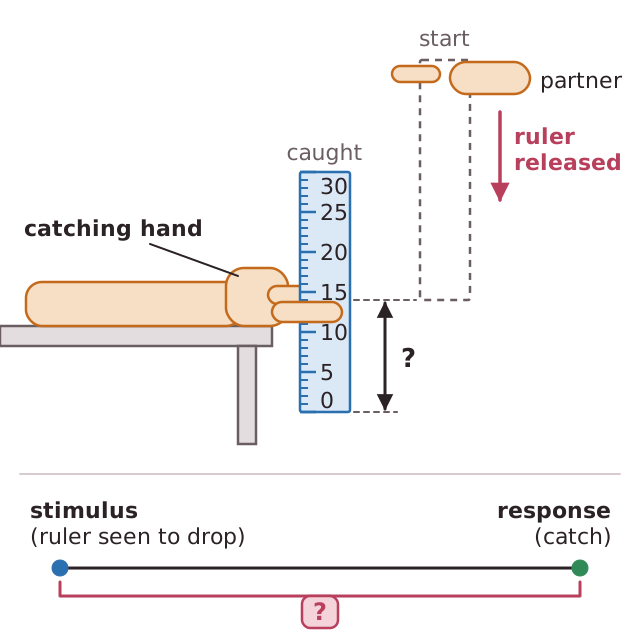
Your reaction time is the time between a stimulus, such as seeing something happen, and your response to it. A typical human reaction time is about 0.2 s. Among different people and conditions it can vary from 0.2 s to about 0.9 s.
In the ruler drop test, one person holds a ruler vertically while a partner holds their thumb and finger level with the zero mark, ready to catch it. The ruler is released without warning and the distance it falls before it is caught is measured. A greater distance means a longer reaction time. The distance can be converted into a time using a table or a formula.
The test is repeated several times and the mean is calculated to make the result more reliable. For example, results of 0.18 s, 0.22 s and 0.20 s give a mean of 0.20 s. To investigate a factor such as caffeine or distractions, only one variable is changed. The same ruler, the same hand and the same person are used to keep the test fair.
A computer reaction test is another method. The person presses a key when the screen changes and the computer measures the time, which is more precise than timing by hand.