Momentum is the product of an object's mass and its velocity: momentum = mass × velocity, or p = m × v. It is measured in kilograms metres per second (kg m/s). Momentum has the same direction as the velocity, so it is a vector quantity. A 1000 kg car moving at 20 m/s has a momentum of 1000 × 20 = 20000 kg m/s.
In a collision, objects push on each other and their momentum changes. If no external forces act, the total momentum before the collision is equal to the total momentum after it. We say that momentum is conserved.
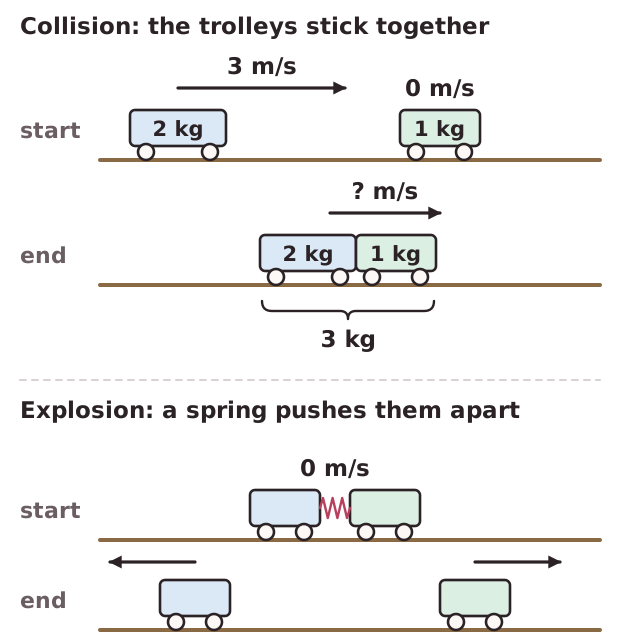
A 2 kg trolley moving at 3 m/s hits a stationary 1 kg trolley and they stick together. The total momentum before is 2 × 3 = 6 kg m/s. After the collision the total mass is 3 kg, so 3 × v = 6 and the trolleys move off together at 2 m/s.
Momentum is also conserved in an explosion. If objects start at rest the total momentum is zero, so they fly apart with equal and opposite momentum and the total momentum afterwards is still zero. A water rocket works like this: the water is pushed down and the rocket shoots up with the same size of momentum.