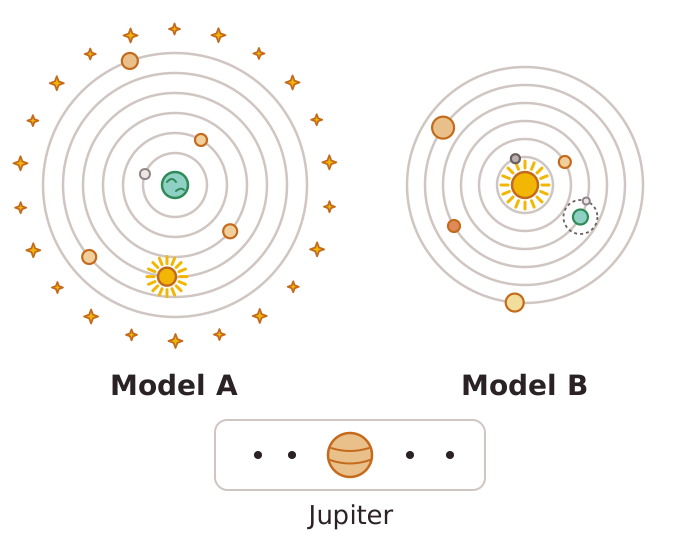
Early astronomers believed in the geocentric model, with the Earth at the centre and the Sun, Moon, planets and stars all moving round it. This matched what people could see by eye. In the 16th century Copernicus proposed the heliocentric model, with the Sun at the centre and the Earth as one of the planets orbiting it.
Better instruments gave new evidence. Around 1610 Galileo used a telescope to see moons orbiting Jupiter, so not everything orbits the Earth. Kepler then showed that planets move in ellipses, not perfect circles. Later, telescopes found Uranus and Neptune, and Pluto was found in 1930. In 2006 Pluto was reclassified as a dwarf planet.
This shows how science works: a model is kept while it explains the evidence, and replaced when better evidence does not fit it.