Work done is the force multiplied by the distance moved in the direction of the force, W = Fx. It is measured in joules, where 1 J = 1 N m.Work done is energy transferred. When you push a crate along a floor at steady speed, the work done against friction is transferred to the surroundings as heat. When you lift an object at steady speed, the work done against gravity is stored as gravitational potential energy.Only the distance moved in the direction of the force counts. If an object moves at right angles to a force, that force does no work on it. The Earth's gravity does no work on a ball rolling along a level floor.
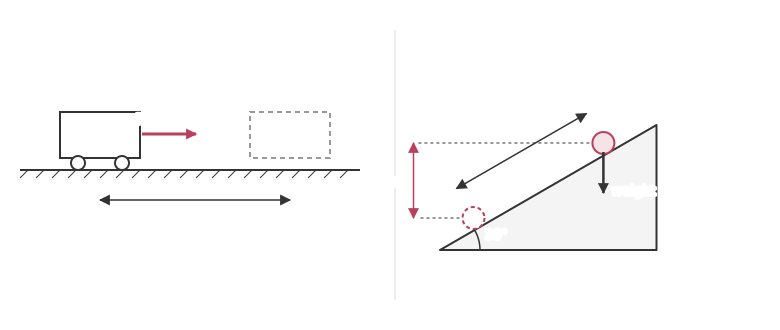
For example, pushing a trolley 10 m with an average force of 70 N does 70 × 10 = 700 J of work. A ball rolling 3 m down a slope at 30° drops a vertical height of 1.5 m, so gravity only does work over that 1.5 m.
Work Done and Energy
Read the text
Read the text and highlight anything you think is important. When you go on, the text is hidden and you answer from memory.
Specification: OCR Physics A (H156), AS-level, 3.3.1 Work and conservation of energy. Topic: Work, Energy and Power.
More in Work, Energy and Power
- Work Done at and Angle to Motion
- Principle of Conservation of Energy
- Forms of Energy
- Kinetic Energy
- Gravitational Potential Energy
- Energy Transfer
- Power
- Power and Motion
All 10 lessons in Work, Energy and Power · All OCR AS-level Physics topics