Whenever energy is transferred by a machine or device, only part of the input energy is transferred to the form we want. The rest is wasted, usually as heat (thermal energy) and sound to the surroundings. Energy is always conserved, so input energy = useful output energy + wasted energy.The efficiency of a device is the ratio of the useful output energy to the total input energy:efficiency = useful output energy ÷ total input energy × 100% Because power is the rate of energy transfer, efficiency can also be calculated from power:efficiency = useful output power ÷ total input power × 100% 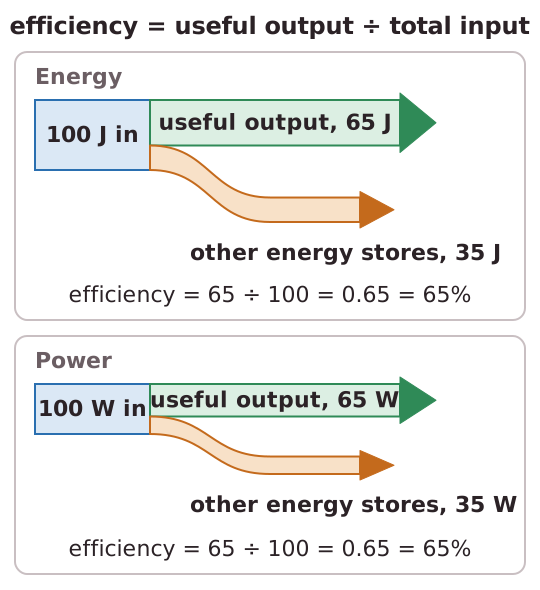 Efficiency has no units. It can be given as a decimal (for example 0.25) or as a percentage (25%). No real device can be more than 100% efficient, because it cannot output more energy than it takes in.For example, an electric motor with an input power of 200 W lifts a load and has a useful output power of 150 W. Its efficiency is 150 ÷ 200 = 0.75, or 75%, and 50 W is wasted as heat and sound.