When two objects interact they exert equal and opposite forces on each other.These forces must be of the same type and act on different objects.For instance a book placed on a table will feel a contact force. There is a force on the book by the table and an equal and opposite force on the table by the book. Both are contact forces.Examples of forces: gravitational, electrostatic, magnetic, normal contact force, frictional, tension, thrust.
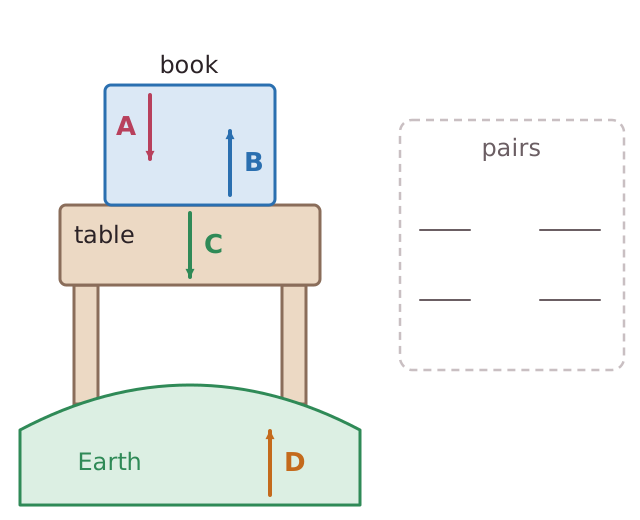
Newton's Third Law of Motion
Newton's third law is about the interaction between objects.
Read the text
Read the text and highlight anything you think is important. When you go on, the text is hidden and you answer from memory.
Specification: OCR Physics A (H156), AS-level, 3.5.1 Newton's laws of motion. Topic: Momentum.
Key terms in this lesson
- velocity
- The rate of change of displacement of an object; speed in a given direction.
- terminal velocity
- The constant maximum velocity reached by an object moving through a fluid when the resultant force on it is zero, because the drag force has become equal to the driving force.
- density
- The mass per unit volume of a substance.
- power
- The rate at which work is done, or the rate of transfer of energy.
More in Momentum
- Newton's First Law of Motion.
- Newton's Second Law of Motion
- The Four Fundamental Forces
- Linear Momentum
- Conservation of Momentum
- Explosions vs Collisions
- Elastic and Inelastic Collisions
- Air Bags
All 14 lessons in Momentum · All OCR AS-level Physics topics