QuestionA 3.0 Ω resistor is connected in series with a parallel pair made of a 6.0 Ω resistor and a 12 Ω resistor. The combination is connected to a 14 V supply of negligible internal resistance. Calculate (a) the total resistance of the circuit and (b) the current drawn from the supply.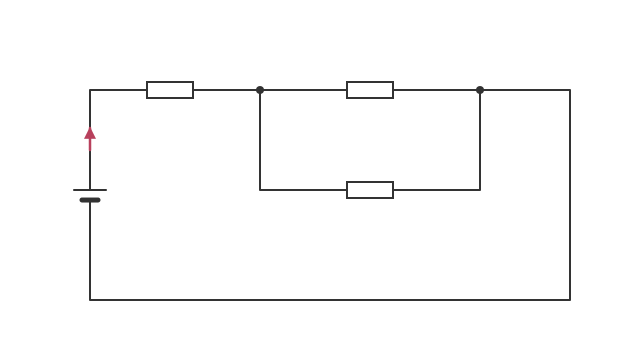
1/R = 1/R1 + 1/R2 = 1/6.0 + 1/12 = 3/12 R = 12/3 = 4.0 Ω Check: the equivalent resistance of a parallel pair is always smaller than the smallest resistor in it (4.0 Ω is less than 6.0 Ω), because each extra branch gives the charge another path.This 4.0 Ω is in series with the 3.0 Ω resistor:Rtotal = 3.0 + 4.0 = 7.0 Ω (b) Supply currentI = V/Rtotal = 14 V / 7.0 Ω = 2.0 A Shortcut: for exactly two resistors in parallel, use 'product over sum':R = R1R2/(R1 + R2) = (6.0 × 12)/(6.0 + 12) = 72/18 = 4.0 Ω It only works for two resistors at a time. For three or more in parallel, add the reciprocals.