Skip to content

Transverse Waves

Wave Motion is the propagation of disturbances, produced on one part of a medium by the vibration of its particles, to all its other parts.Transverse Waves are waves for which the direction of vibration is perpendicular to the direction of wave travel.The displacement of each particle as it vibrates about an equilibrium position is modelled by a sine wave. Sine waves are periodic and have a positive maximum value A and a negative minimum value -A in the opposite direction.As each particle oscillates, it disturbs an adjacent particle which then follows its sinusoidal movement after a delay δt.Examples are electromagnetic waves and secondary seismic waves.
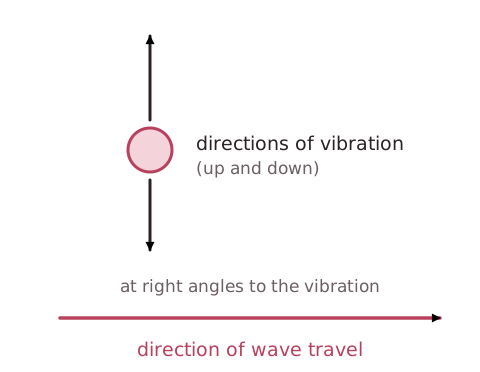
All waves transfer energy from one place to another without transferring matter.Electromagnetic waves are transverse without requiring a medium.The direction of the wave is perpendicular to the displacement of the particles of the medium through which it passes, or in the case of EM waves, the oscillation is perpendicular to the direction of the wave.

Read the text

Read the text and highlight anything you think is important. When you go on, the text is hidden and you answer from memory.

Specification: AQA Physics (7407), AS-level, 3.3.1.2 Longitudinal and transverse waves. Topic: Waves.

Key terms in this lesson

Refraction
The change of direction of a wave as it crosses a boundary between two media in which it travels at different speeds.

More in Waves

All 24 lessons in Waves · All AQA AS-level Physics topics