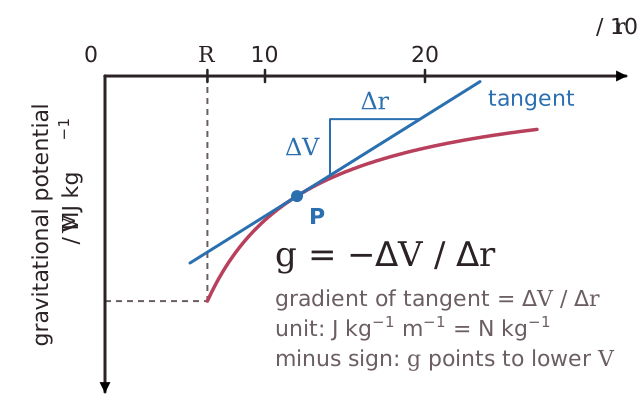
The gravitational potential gradient at a point is the change in gravitational potential per metre, ΔVg/Δr. Its unit is J kg-1 m-1, which is the same as N kg-1.The gravitational field strength is equal to the negative of the potential gradient, g = -ΔVg/Δr. The minus sign shows that the field points in the direction in which the potential decreases, towards the mass.On a graph of Vg against r, the gradient of the tangent at any point gives the potential gradient, and so the magnitude of g, at that distance. Because Vg = -GM/r, the curve rises towards zero and becomes less steep further from the planet, showing that the field gets weaker.
Lines joining points of equal potential are called equipotentials. No work is done moving a mass along an equipotential, and field lines always cross equipotentials at right angles. Where equipotentials are closer together, the potential gradient and the field strength are greater.
Potential Gradients
Read the text
Read the text and highlight anything you think is important. When you go on, the text is hidden and you answer from memory.
Specification: OCR Physics A (H556), A-level, 5.4.4 Gravitational potential and energy and 5.4.2 Newton's law of gravitation. Topic: Gravitational Fields.
Key terms in this lesson
- capacitor
- A component that stores electric charge, consisting of two conducting plates separated by an insulator, called a dielectric.
More in Gravitational Fields
- Gravitational Potential.
- Equipotentials.
- The potential gradient.
- Newton's Law of Gravitation.
- Gravitational Field Strength - g.
- Gravitational Potential.
- Area Under a Force vs Distance Graph
- Satellites
All 14 lessons in Gravitational Fields · All OCR A-level Physics topics