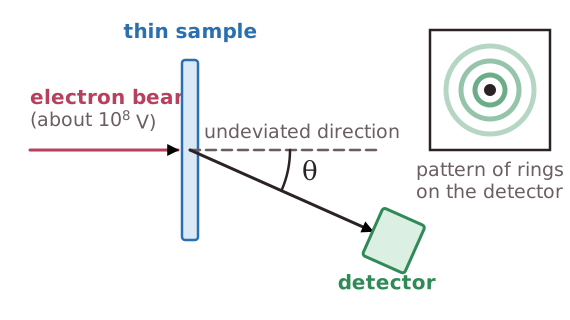
The diameter of a nucleus is a few fm (1fm = 10-15m). If an electron beam is accelerated through about 100 million volts and passed through a thin slice of solid material diffraction occurs. The angle of diffraction θ and the number of electrons emitted per second can be measured by a detector.Scattering occurs due to the electron beam being attracted by the nuclei. This causes the intensity to decrease as θ increases.Diffraction occurs causing maxima and minima of varying intensities due to the scattering effect. θ, the angle of the first minimum measured from the straight-through (zero-order) beam, can be used to measure the diameter of the nuclei.