The direction of the induced current is always such as to oppose the change that causes a current.When the north pole of a bar magnet is pushed into a coil, the induced current makes the end of the coil nearest the magnet a north pole. This repels the incoming magnet, so work must be done to push it in. When the magnet is pulled out, the current reverses and that end becomes a south pole, which attracts the magnet and opposes its removal. A meter connected to the coil deflects in opposite directions in the two cases.Lenz's law follows from the conservation of energy. If the induced current helped the change instead, the magnet would speed up and electrical energy would be produced from nothing. Because the induced current opposes the motion, work is done against this opposing force, and that work is the source of the electrical energy in the circuit.Lenz's law gives the minus sign in Faraday's law:ε = −d(NΦ)/dt Examples:
• a magnet dropped through a coil that is part of a complete circuit falls more slowly, because the induced current produces a force that opposes its motion;
• a metal sheet swinging through a magnetic field is slowed by induced eddy currents (electromagnetic braking).The direction of the current induced in a moving wire can be found using Fleming's right-hand rule.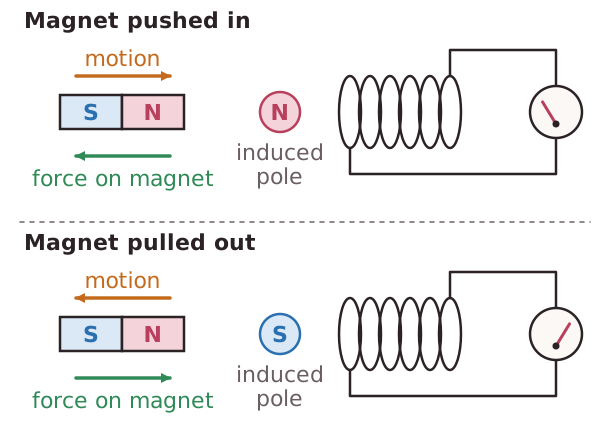
• a magnet dropped through a coil that is part of a complete circuit falls more slowly, because the induced current produces a force that opposes its motion;
• a metal sheet swinging through a magnetic field is slowed by induced eddy currents (electromagnetic braking).The direction of the current induced in a moving wire can be found using Fleming's right-hand rule.