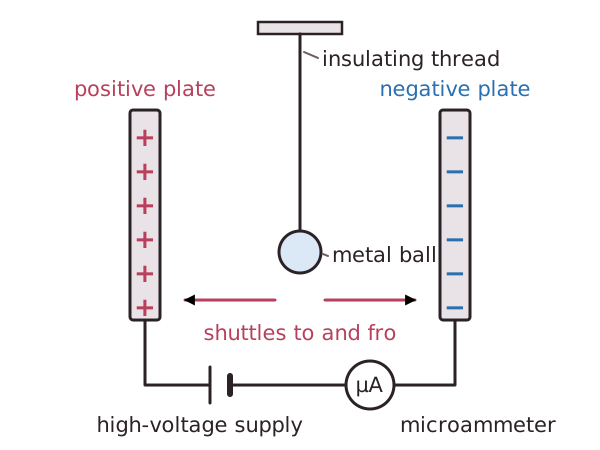
If you suspend a metal ball by an insulating thread between two vertical plates the ball shuttles back and forth when a high voltage is applied across the two plates.The ball has a conducting surface (for example, it is coated with metal paint) so charge can flow onto and off it. Suppose the ball first touches the positive plate. Electrons flow from the ball to the plate, so the ball becomes positively charged. Like charges repel, so the ball is pushed away from the positive plate and attracted towards the negative plate.When the ball touches the negative plate, electrons flow onto it. It becomes neutral and then gains extra electrons, so it is now negatively charged. It is repelled by the negative plate and attracted back to the positive plate, where it gives up those electrons again. The cycle repeats and the ball shuttles back and forth.Each time the ball crosses the gap it carries charge from one plate to the other, so a small current flows in the circuit. A sensitive meter connected in series with the plates shows this current, which is the charge carried per second. Increasing the potential difference makes the ball carry more charge on each trip and shuttle faster, so the current increases.The experiment shows that an electric current is a flow of charge.