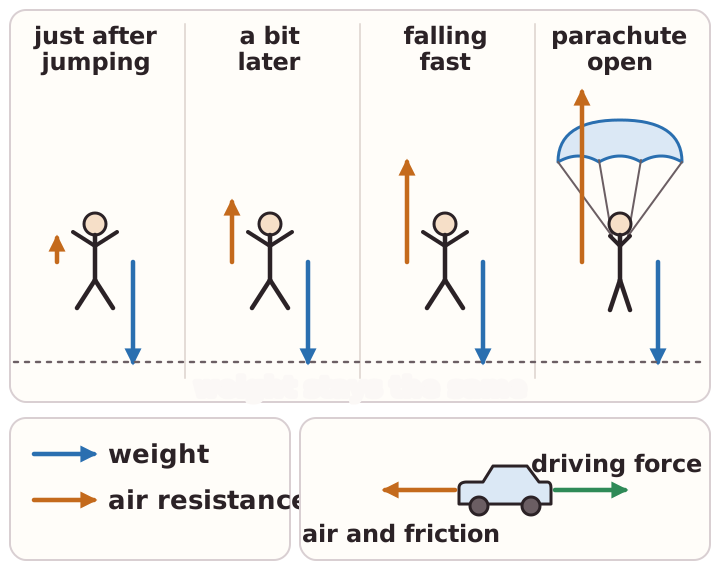
To describe the forces on an isolated object, consider only the forces acting on that object. A skydiver who jumps from a plane has two: weight acting down and air resistance, also called drag, acting up. Weight stays the same. Air resistance gets bigger as the speed increases.
At the start the speed is low, so air resistance is small and the resultant force down is large. The skydiver accelerates. As speed rises, air resistance grows, the resultant force shrinks and the acceleration gets smaller. Eventually the air resistance is equal to the weight. The resultant force is now zero, so by Newton's first law the skydiver falls at a constant speed. This is the terminal velocity.
Opening the parachute makes the air resistance much bigger than the weight, so the skydiver slows down. As the speed falls, air resistance drops until it equals the weight again, giving a smaller terminal velocity. Vehicles work in a similar way. A car reaches its top speed when the driving force from the engine is equal to the total resistive forces, which are air resistance and friction.