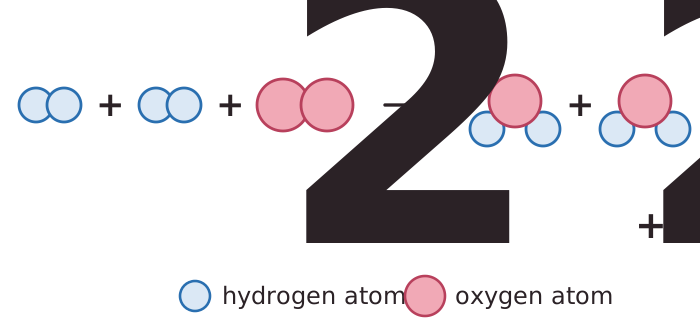
In a chemical reaction atoms are rearranged, but none are created or destroyed. This is the conservation of mass: the total mass of the reactants equals the total mass of the products. Because of this, a chemical equation must be balanced, with the same number of atoms of each element on both sides.
To balance an equation, write the word equation, then the formulae, then count the atoms of each element. Change the big numbers written in front of formulae until the counts match. Never change the small numbers inside a formula, because that would change the substance. For hydrogen burning in oxygen: 2H2 + O2 → 2H2O. There are four hydrogen atoms and two oxygen atoms on each side. The 2 in front of H2O means two molecules of water.
For magnesium burning: 2Mg + O2 → 2MgO. In this reaction 48 g of magnesium reacts with 32 g of oxygen to make 80 g of magnesium oxide. In an open container the mass can seem to change. Magnesium gains mass as it burns, because it combines with oxygen from the air. When a carbonate is heated and the mass seems to decrease, a gas has escaped. In a sealed container the total mass stays the same.