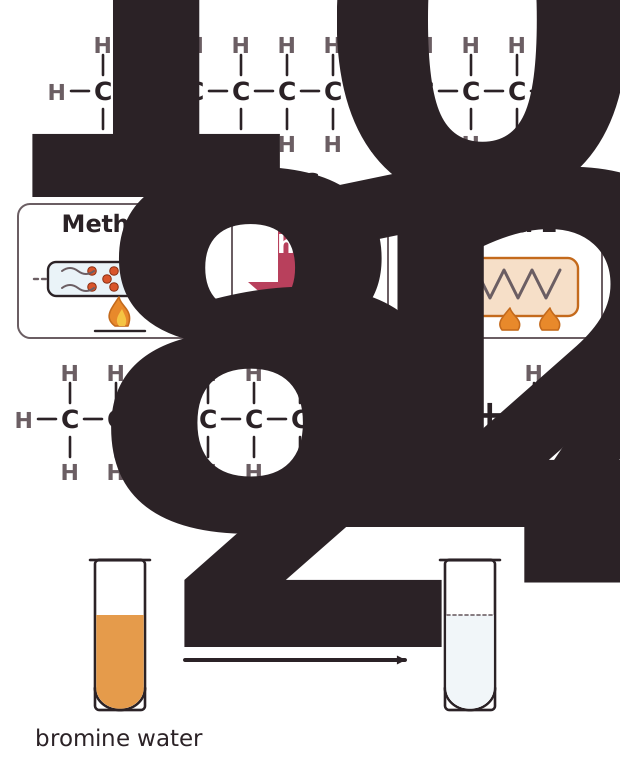
Cracking breaks down large hydrocarbons into smaller, more useful molecules. There is a high demand for fuels with small molecules, so some of the products of cracking are useful as fuels.
There are two main methods. In catalytic cracking, the hydrocarbon vapour is passed over a hot catalyst. In steam cracking, the hydrocarbon is mixed with steam and heated to a very high temperature. The products include alkanes and another type of hydrocarbon called alkenes. For example, C10H22 → C8H18 + C2H4. The equation balances because the carbon atoms (10 = 8 + 2) and hydrogen atoms (22 = 18 + 4) are the same on both sides. The other product, C2H4, has two carbon atoms and four hydrogen atoms.
Alkenes are more reactive than alkanes. They react with bromine water, which is used as the test for alkenes: bromine water turns from orange to colourless when shaken with an alkene. With an alkane the bromine water stays orange.
Alkenes are used to produce polymers and as starting materials for the production of many other chemicals. Modern life depends on hydrocarbons for fuels, polymers and other materials, and cracking helps match supply to demand.