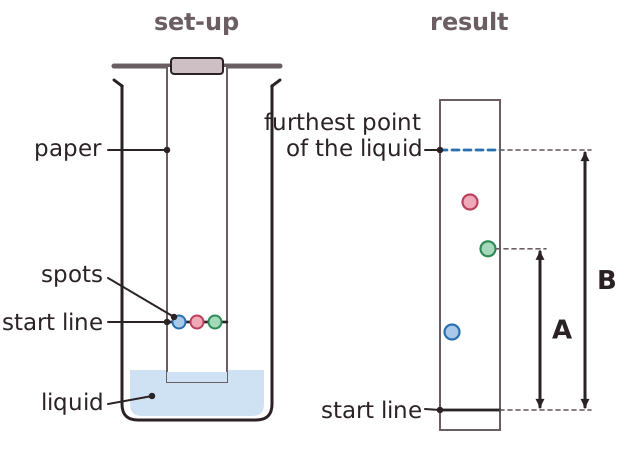
Chromatography separates the substances in a mixture and gives information that helps identify them. It uses two phases. The stationary phase does not move, and in paper chromatography it is the paper. The mobile phase moves through the stationary phase, and it is a solvent such as water. Each substance in the mixture is shared between the two phases. A substance that dissolves well in the solvent and sticks weakly to the paper is carried further up the paper, so different substances separate into different spots.
Method (required practical 12): draw a start line in pencil near the bottom of a piece of chromatography paper. Pencil is used because ink would dissolve in the solvent and spread up the paper with the samples. Put a small spot of each coloured substance on the line, then stand the paper in a beaker with a little solvent. The solvent level must be below the start line. The solvent soaks up the paper and carries the substances with it. Take the paper out before the solvent reaches the top, mark the solvent front in pencil straight away, and leave the paper to dry.
The distance moved by each spot is measured from the start line to the centre of the spot. The Rf value is a ratio: Rf = distance moved by substance ÷ distance moved by solvent. A spot that moved 4.5 cm while the solvent moved 9.0 cm has Rf = 4.5 ÷ 9.0 = 0.50. The solvent always moves further than any substance, so an Rf value is between 0 and 1, and it has no units. Give it to a sensible number of significant figures, usually two.
A given compound has the same Rf value in the same solvent but different Rf values in different solvents, so Rf values can be compared with known values to help identify it. A pure compound gives a single spot in every solvent. An impure substance may separate into more than one spot, depending on the solvent.