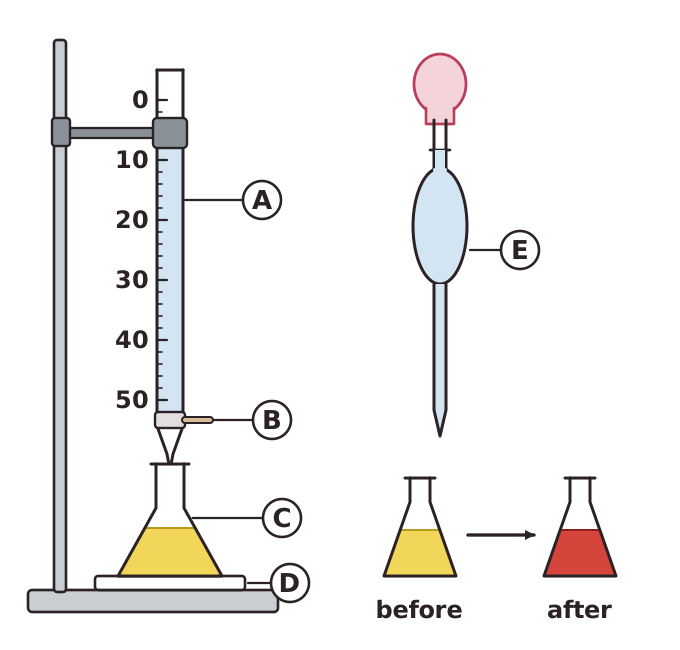
A titration is a technique for finding exactly how much of one solution reacts with a measured volume of another. In an acid-alkali titration the aim is usually to find the volume of acid that just neutralises a fixed volume of alkali.
A pipette measures an exact volume of alkali, for example 25.0 cm3, into a conical flask. A few drops of indicator are added. Methyl orange is yellow in alkali and red in acid, and phenolphthalein is pink in alkali and colourless in acid. The acid goes in a burette and the starting reading is recorded. The acid is added a little at a time while the flask is swirled, with the flask standing on a white tile so the colour change is easy to see.
Near the end the acid is added drop by drop. The end-point is the moment the indicator changes colour permanently, which shows the alkali has just been neutralised. The final burette reading is recorded, and the volume of acid used, called the titre, is the final reading minus the start reading.
The first titration is a rough one. It is then repeated more carefully until two or more results agree within 0.10 cm3. These are concordant titres. For example, careful results of 23.40 cm3 and 23.50 cm3 are concordant, and their mean is 23.45 cm3. The rough titre is not used in the mean.