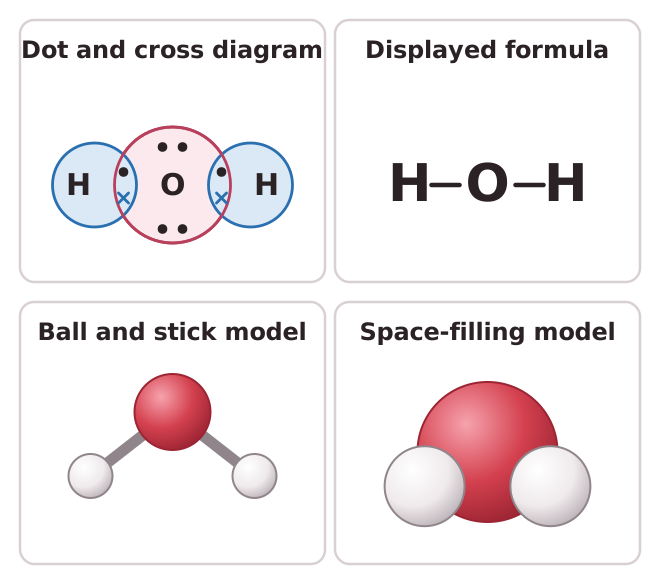
Chemists use models and diagrams to represent structures, but every one has limitations.
A dot and cross diagram shows the outer-shell electrons of each atom and the pairs that are shared in covalent bonds. It does not show the shape of the molecule or the relative size of atoms, and it is flat. The dots and crosses also suggest the electrons are different, when all electrons are identical.
A ball and stick model shows the three-dimensional shape of a molecule, the bond angles and which atoms are bonded. However, the balls are not the correct size, atoms are not solid spheres, and the sticks make bonds look like solid rods. It does not show the electrons that form the bonds.
Two-dimensional diagrams are quick to draw and show which atoms are bonded, but they cannot show the true shape of a molecule. Three-dimensional models show the shape, but a model of a giant structure such as an ionic lattice shows only a small part of it. Models are also static, whereas real particles are always vibrating.