A titration is an analytical and quantitative technique to determine the volume of one solution that exactly reacts with a known volume of another solution.
Titrations can be used to find unknown concentrations or determine the molar mass and hence the identity of a compound. Titrations can also be used to determine the purity of a compound.
The procedure consists of measuring a known volume of one solution typically 25cm3 with a pipette and placing it in a conical flask and another solution in a burette.
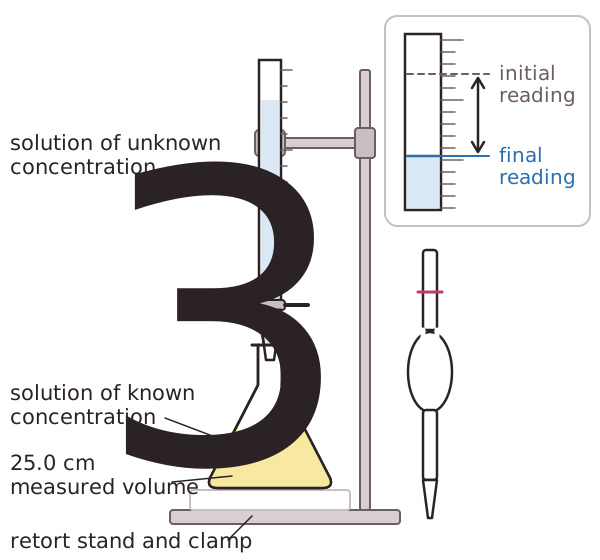 The solution in the burette is run into the solution in the conical flask until an indicator which has been added to the flask changes colour. This is called the end point of the titration.
The difference between the initial and final burette readings is called the titre.
The titration is repeated until two concordant titres (agreeing to within 0.1 cm3) are obtained. The burette is read to the nearest half division. A 50 cm3 burette has a tolerance of ±0.10cm3.
A 10 cm3 pipette has a tolerance of ±0.04cm3 and a 25 cm3 pipette has a tolerance of ±0.06cm3