Melting and Boiling Temperatures
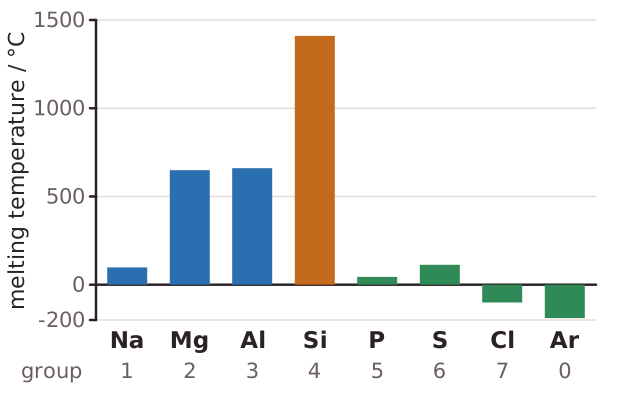
The melting temperature increases across period 3 from group 1 to group 3. This is because the elements are metals and there are more delocalised electrons involved in the metallic bonding. The melting temperature of silicon (group 4) is very high as Si has a giant covalent structure. The melting temperature then falls sharply because P, S and Cl exist as simple molecules (P
4, S
8 and Cl
2) held by weak
London forces. It is not a steady fall: S
8 has the most electrons, so sulfur melts higher than phosphorus. Argon exists as single atoms and has the lowest melting temperature.
| group | 1 | 2 | 3 | 4 | 5 | 6 | 7 | 0 |
| element | Na | Mg | Al | Si | P | S | Cl | Ar |
| structure | metallic | metallic | metallic | giant covalent | simple molecules | simple molecules | simple molecules | atoms |
| melting temperature / °C | 98 | 649 | 660 | 1410 | 44 | 113 | -101 | -189 |